
On May 11, 2026, YAGI Co., Ltd. (securities code: 7460; hereinafter the “Company” or “YAGI”), one of the core portfolio companies of Hibiki Path Advisors SPC (“Hibiki,” “we,” or “our”), announced its ambitious Medium-Term Management Plan 2029 (Business to Belief), “MTP”. As a constructive and supportive shareholder, we have sought through our previous posts to introduce the Company to capital-market participants from a variety of perspectives. In this final installment of our five-part series on YAGI, we consider the intrinsic value of YAGI’s shares and the management stance required to realize that value¹.
1. Intrinsic Value
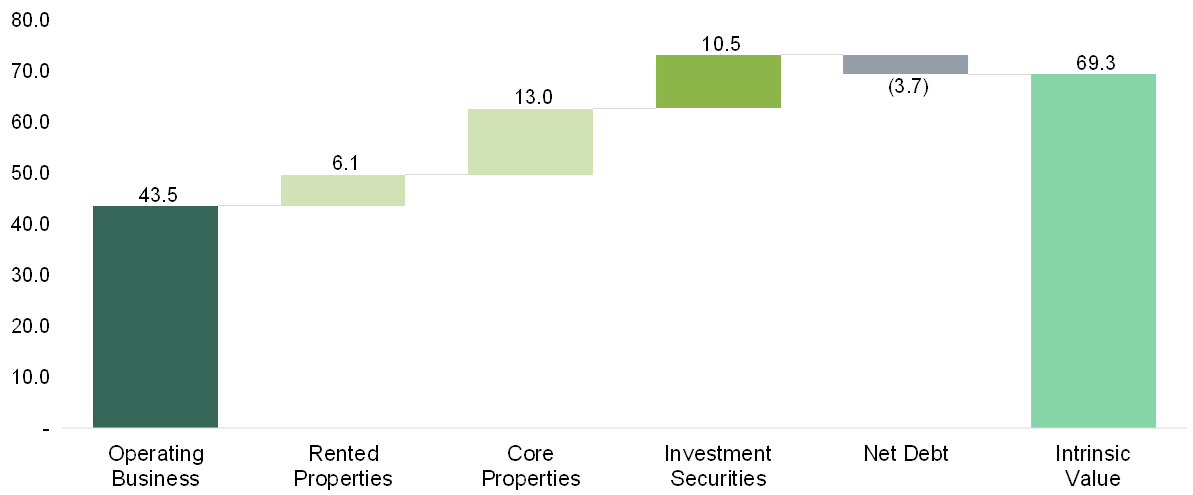
YAGI’s share price as of yesterday was JPY 1,607, rising approximately 22% in three months since the day before the announcement of its MTP, which indicates that the market is starting to recognize the value and the potential of the business. Nevertheless, the P/B ratio remains below 1.0x, and the shares still appear undervalued based on our assessment. We estimate the intrinsic equity value of YAGI’s at approximately JPY 69.3 billion, or JPY 2,780 per share. Below, we start by briefly explaining the basis for our estimate. We use a sum-of-the-parts valuation, dividing the Company’s value into five components: its operating businesses, investment securities, rental real estate, its core properties in Tokyo/Osaka, and net debt. Please see below.
Figure 1 Intrinsic Value (Sum of the Parts)
(unit: Yen bn)
(Source: Hibiki Path Advisors SPC)
Operating Business Value: JPY 43.5 Billion
This is our estimate of the value for YAGI’s core textile trading and brand businesses-which alone, in our view, are worth JPY 43.5 billion, or approximately JPY 1,750 per share. The calculation is simple: we assume normalized net income of JPY 3.5 billion (which excludes cashflow from its rental properties) and apply a P/E multiple of 12.5x. First, while the Company targets net income of JPY 4.7 billion in FY3/29, the final year of its MTP, we take a conservative approach by starting with the FY3/27 forecast of JPY 3.7 billion and deducting earnings from rental real estate income. Second, the 12.5x P/E multiple is derived using a dividend discount model—specifically, the constant-growth Gordon Growth Model, which is commonly used in theoretical share-price valuation. Varying the underlying assumptions produces an indicated range of 12.5x to 20.0x, and we adopt the bottom end of that range. We regard even 12.5x as a conservative assumption, given that the highly profitable Brand Business, including TATRAS, currently contributes approximately 40% of Group earnings and offers promising medium- to long-term growth potential. For reference, applying a somewhat more assertive 15.0x P/E multiple to the FY3/29 net-income target of JPY 4.7 billion would increase the operating business value from current JPY 43.5 billion to JPY 67.0 billion.
Rental Real Estate: JPY 6.1 Billion
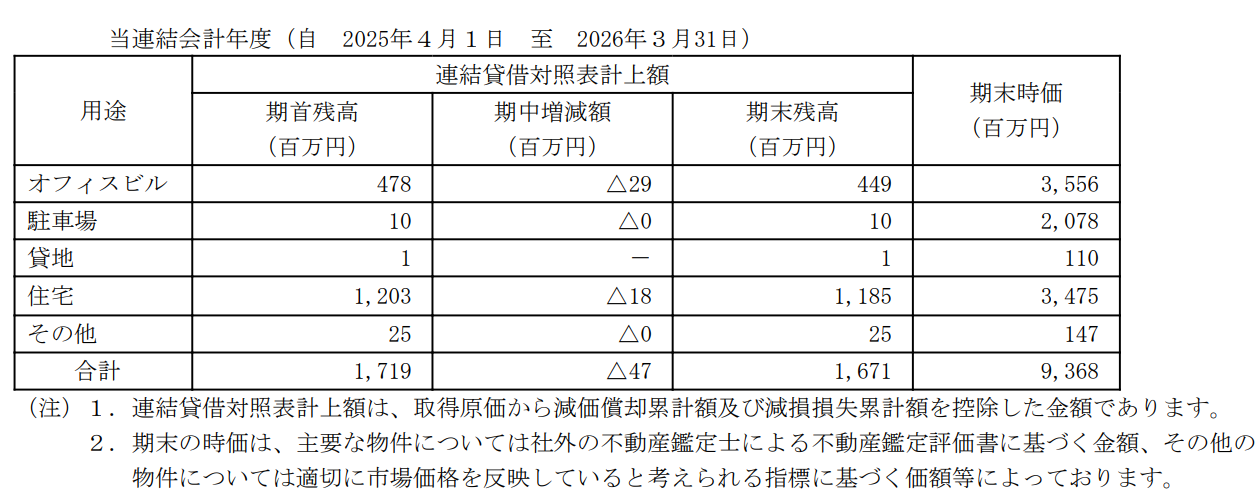
Details of the rental real estate are disclosed on pages 107-108 of the Company’s Annual Securities Report for FY3/26. YAGI is not only a company with a long history; it has also undertaken numerous acquisitions over the years in order to survive and grow. We infer that some of the acquired companies brought real estate onto the Group’s balance sheet. The appraised market value of the rental properties is reported at approximately JPY 9.4 billion as of FY3/26, compared with a book value of approximately JPY 1.7 billion. We assume that the unrealized gain of JPY 7.7 billion with JPY 1.7 billion book value would translate into JPY 7.1 billion total asset value after estimated taxes, and that this net value would be realized evenly over five years at approximately JPY 1.4 billion per year. Discounting those annual amounts to present value at an assumed cost of equity of 8% produces an estimated value of JPY 6.1 billion, or approximately JPY 245 per share. In our view, assets that add value to the business should be retained, while those that do not should be monetized as promptly as practicable, with the proceeds allocated in a balanced manner between growth investment and shareholder returns. We believe YAGI’s MTP points broadly in this direction. We shall return to this topic later.
Figure 2: Details of Rented Properties (Japanese only)
(Source: March 2026 Yagi Securities Report Co., Ltd.)
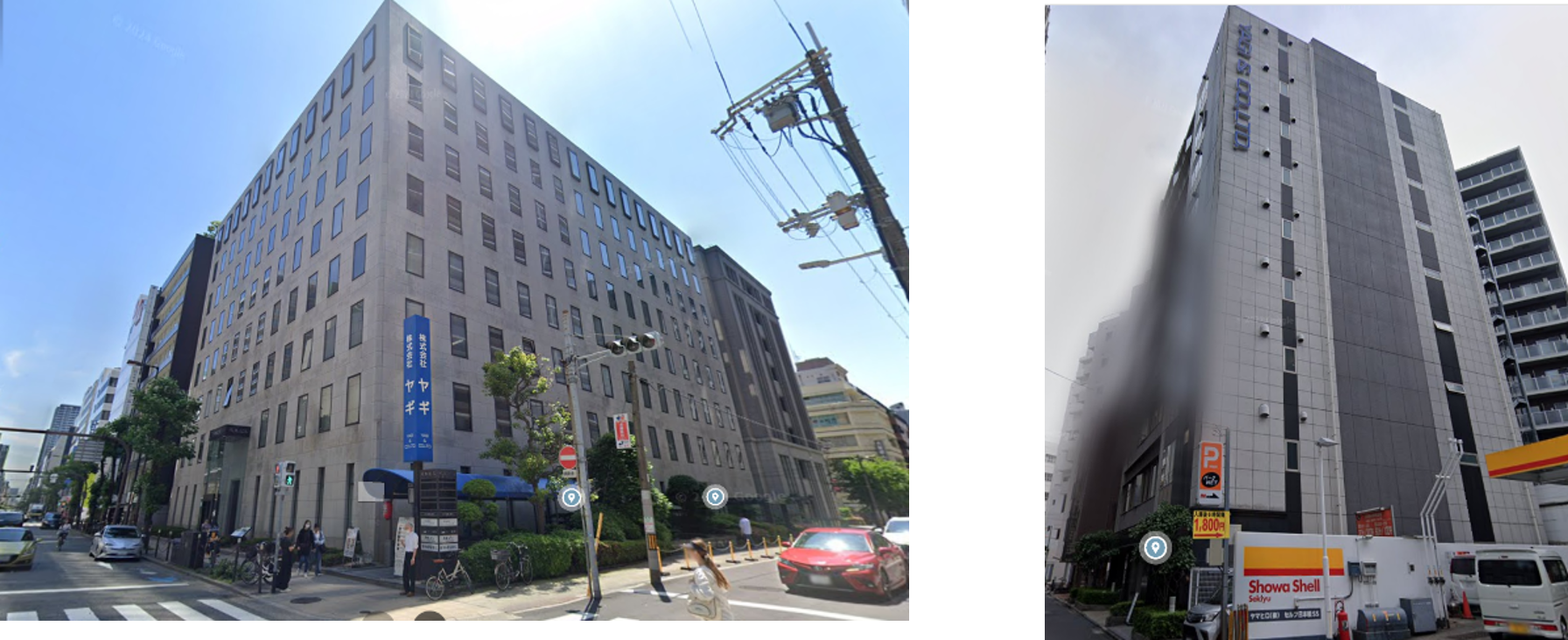
This too is prime central Tokyo real estate, in an area where business hotels catering to inbound travelers have proliferated in recent years. In light of the recent rise in real estate values in Japan, we estimate the combined pre-tax gross value of the two properties at approximately JPY 25.0 billion.
Figure 3: Osaka Head Office (left) and ex-Tokyo Head Office (right)
(Source: Google Maps)
Because the land underlying both properties has been held for many years, its book value is extremely low. We estimate that the combined after-tax value would nevertheless reach JPY 18.0 billion. This value belongs, of course, to all shareholders, including the founding family. Using a scenario separate from that applied to the rented properties, we assume that the value be realized evenly for shareholders over a longer period of ten years. Discounting those amounts at the cost of equity produces a present value of JPY 13.0 billion(approximately JPY 520 per share). Whether either property should be sold is a matter for YAGI to determine based on a comprehensive assessment. Even if the Company decides to retain them, however, we believe management has a responsibility, consistent with the direction of today’s capital markets reforms, to increase corporate value so that the value of the properties ultimately accrues to shareholders in some form, even after allowing for the cost of capital. Ten years may seem short in the context of YAGI’s long history, but it is exceptionally long by conventional valuation standards; reliably forecasting a company’s earnings for ten years is practically impossible. During such a period, real estate prices, interest rates, inflation, and domestic and international conditions could all change materially. While asset values are high, there may therefore be merit in realizing part of this value and using the proceeds to fund investment in TATRAS’s growth, M&A, and shareholder returns.
Investment Securities: JPY 10.5 Billion
The investment securities consist primarily of cross-held shareholdings and bonds. This value is calculated by taking the aggregate amount disclosed on pages 93-97 of the Annual Securities Report and deducting deferred tax liabilities on the consolidated balance sheet, which include the estimated tax charge on unrealized gains in securities. Because these are liquid assets that can be monetized within one to two years, we use the full amount without applying a present-value discount.
Net Debt: Negative JPY 3.7 Billion
This figure represents cash and deposits less long & short-term borrowings and retirement/pension liabilities.
Even after applying a number of above conservative assumptions and allowing generous time horizons, we estimate YAGI’s intrinsic value at JPY 69.3 billion, 77% above its current market capitalization. We have great respect for the Company’s survival instinct maneuvering the difficult journey through repeated periods of turbulence and for its deep expertise in textile materials. We also have high expectations for the future of the Brand Business, led by TATRAS, and the Retail Business. Quite apart from such qualities, which might fairly be described as “priceless”, a dispassionate analysis of the Company’s intrinsic value continues to indicate, in our view, that YAGI remains an attractive investment today.
2. The Significance of Estimating Intrinsic Value
At this point, we would like to take a brief detour from YAGI itself and discuss the significance, for investors, of estimating intrinsic value—even though such an exercise may, in a sense, appear purely theoretical. This question also touches on why investors exist in the first place. Here, we use the term “investors” in the narrower sense of institutional investors who owe accountability and fiduciary duty to their clients.
The business of an investor is to generate investment returns and enable clients to benefit from the resulting value; producing returns is therefore the investor’s overriding mission. A normal operating company has fundamentally the same mission: utilizing its human capital, assets/infrastructure, and capital to provide customers with goods and services, receiving consideration in return, and thereby generating returns for shareholders. For an investor, however, the preferred source of those returns is to buy a company’s shares when, for whatever reason, the market price is below intrinsic value. This requires a constant effort to quantify “value” as far as possible. Over the long history of capital markets, readily comparable measures such as P/E and P/B ratios have accordingly developed into widely used valuation indicators. As an aside, the presence of many investors who estimate value independently and act on their conclusions creates diversity and liquidity in the market. The intersection of those differing views—where selling and buying interest meet—forms the share price at any given moment. It is no exaggeration to say that a diverse investor base supports one of the essential preconditions for capitalism to function effectively.
Investors differ widely in how they perceive value. Some short-term investors focus only on movements in near-term cash flow and earnings, with little or no regard for asset value. Many others, including ourselves, seek to calculate in as much detail as possible the value that belongs to shareholders in a theoretical sense—what we call “intrinsic value”—including elements not captured in current cash flow. There is no question of right or wrong here; only a difference in perspective.
The value of considering real estate and investment securities that cannot be seen from an analysis of YAGI’s core business alone can also be understood by looking at the reverse case. If a company invested in building a factory but the investment failed to generate the expected returns, investors might critically ask whether the asset should be impaired (i.e. loss of intrinsic value). When such demanding investors trade in the market, they help improve market efficiency and drive the economy, however incrementally, closer to what economists call a Pareto optimum. Market efficiency is vital to the optimal allocation of resources across the economy and is a foundation of economic development. In fact, such dynamic move towards the optimum equilibrium is the ultimate macro-economic destination of “maximizing corporate value” at micro scale. From this perspective, the process of investors and management discussing intrinsic value and aligning on the goal of maximizing corporate value is not merely something to which we should aspire, but a basic mode of conduct for responsible citizens that is already contemplated in the core of economic theory.
Returning to YAGI, our calculation includes real estate, investment securities, and other components that may not be directly related to cash flow from the core business. Yet these too form part of YAGI as it stands today, shaped by the Company’s historical path. Management and the Board must continually ask themselves whether to crystallize the value of these assets through disposals or retain them within the Company and maximize corporate value organically—and, if the latter, how—and must remain accountable for their answers. Investors, for their part, must continue to pose these questions. We believe that this ongoing process contributes to maximizing corporate value.
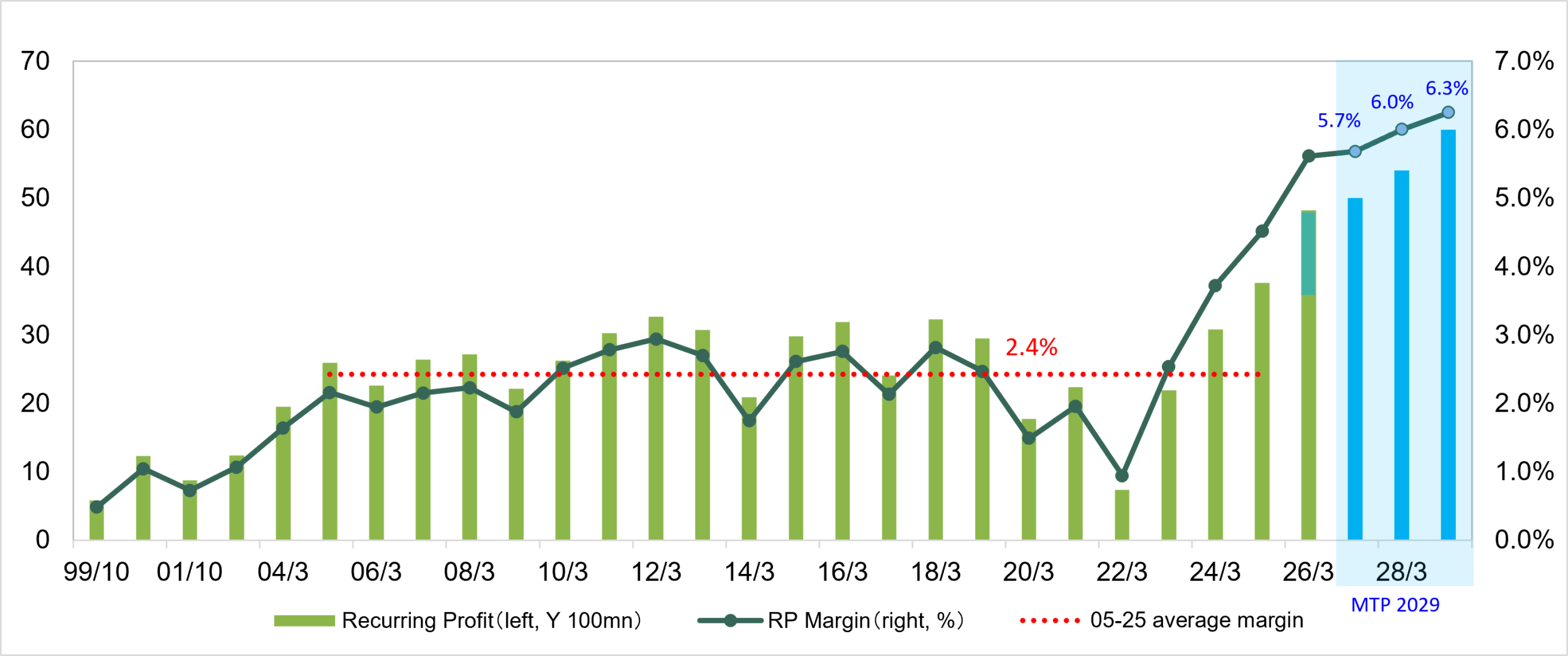
YAGI’s recurring profit margin averaged only 2.4% over the past decade, and its P/B ratio has constantly remained below 1.0x. In recent years, however, profitability has improved visibly, reflecting the cumulative effect of measures to strengthen the profitability of the Material and Apparel Businesses with the strong growth of the Brand Business led by TATRAS. The share price has responded, rising by 259% over the past three years. In our view, however, it remains substantially undervalued relative to intrinsic value. At the same time, the opportunity to recycle and deploy its “physical asset value” that has accumulated over many years into investment for future growth has finally become more compelling. Those growth investments must themselves be chosen with the rigorous discipline of an investor mindset—that is, with a clear view as to whether they will generate medium- to long-term solid returns. Management also faces the challenge of maintaining an appropriate balance with shareholder returns and translating a strong awareness of intrinsic value into the share price.
Figure 4: Yagi’s Recurring Profit History and Future Plan
(Source: YAGI and Hibiki Path Advisors SPC)
3. The Medium-Term Management Plan and Management’s Approach
Lastly, we revisit the Company’s MTP, which we examined in detail in Part 1, this time through the lens of “intrinsic value”. We then discuss two aspects of YAGI management’s approach that we have not addressed extensively in our previous posts. The key financial and shareholder-related measures in YAGI’s MTP 2029 are as follows:
・A dividend payout ratio of at least 40%, together with a target total payout ratio of approximately 70%, clearly demonstrating an intention to conduct ongoing share buybacks
・A three-for-one stock split to improve liquidity (completed)
・Cancellation of 840,000 treasury shares, equivalent to nearly all treasury stock held (completed)
・A new share-buyback program equivalent to 3.3% of shares outstanding, running from July 2026 through March 2027
The plan goes beyond simply increasing earnings. It comprises a virtually comprehensive package of measures designed to address the interests of each and every shareholder and enhance shareholder value, including steady increase in dividends, the cancellation of treasury shares, additional share buybacks, a stock split, together with a long-term ROE target of 12%.
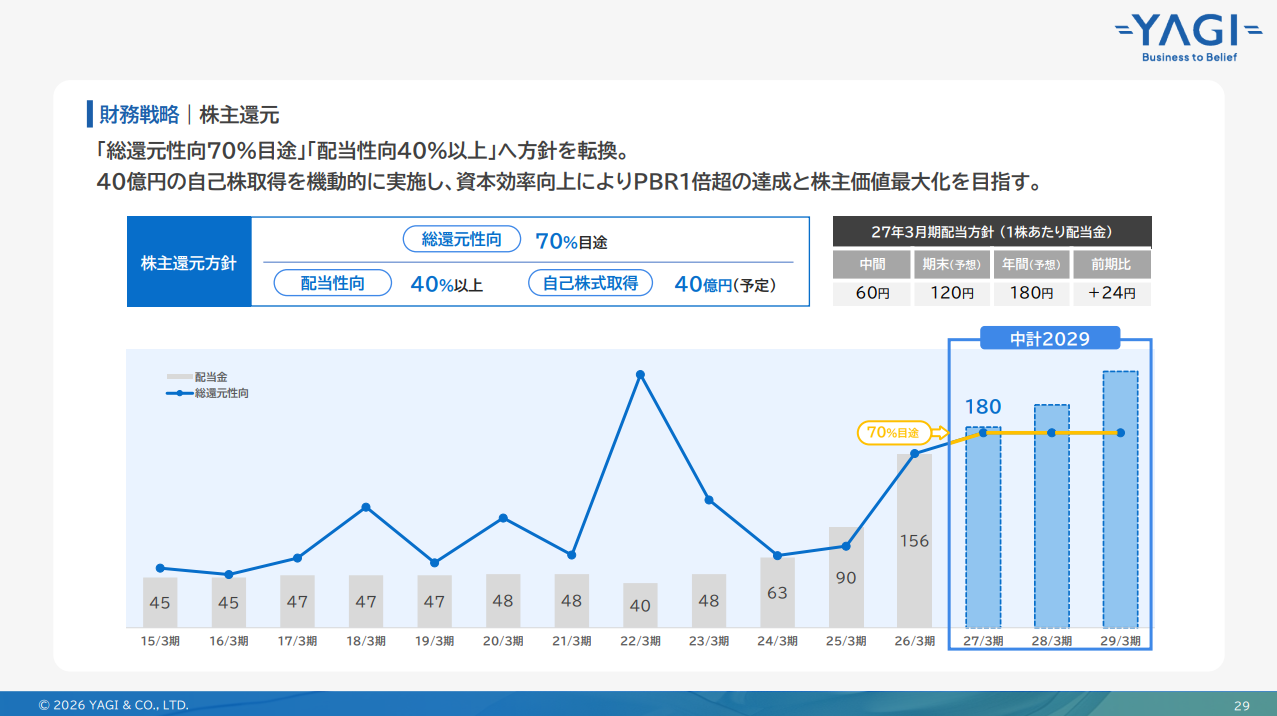
Figure 5: YAGI’s Shareholder Return Policy (Japanese only)
(Source: YAGI MTP2029 presentation materials)
The slide shown in Figure 5 is where we most clearly sensed management’s resolve. In addition to stating the Company’s shareholder-return policy and the planned amount of share buybacks, it declares: “By improving capital efficiency, we aim to achieve a P/B ratio above 1.0x and maximize shareholder value.” One could dismiss this as a matter of wording alone. Yet the phrase appears in an important document setting out the future direction of a listed company, and for that reason it should not be overlooked.
Majority, if not most, of Japanese companies, including some of our portfolio companies, use the softer, more carefully wrapped phrase “aim to enhance corporate value” in their investor-relations materials. We ourselves used the term “corporate value” earlier in this post. YAGI, however, has replaced:
“Corporate value” with “shareholder value”
“Enhance” with “maximize”
“Corporate value” carries a degree of definitional ambiguity because it includes the value of debt and other claims in addition to shareholder value. “Shareholder value,” by contrast, leaves no room for ambiguity. Similarly, “enhance” is almost a magic word: it can be used whether value increases by one yen or JPY 10.0 billion. “Maximize” allows no such definition leakage. Management would not voluntarily choose these words “by accident” in a document of such importance. We were quietly impressed because this single expression, in our view, that captures management’s resolve. As discussed above, maximizing value is entirely natural for the rational individual assumed by economic theory. Yet after a long period of struggling through a world in which what should have been obvious did not always prevail, a clear expression of this resolve by management makes us genuinely want to support the Company. We strongly hope that many more corporate leaders will demonstrate a similar stance to express in direct and simple terms what they are really aiming for in their corporate journey.
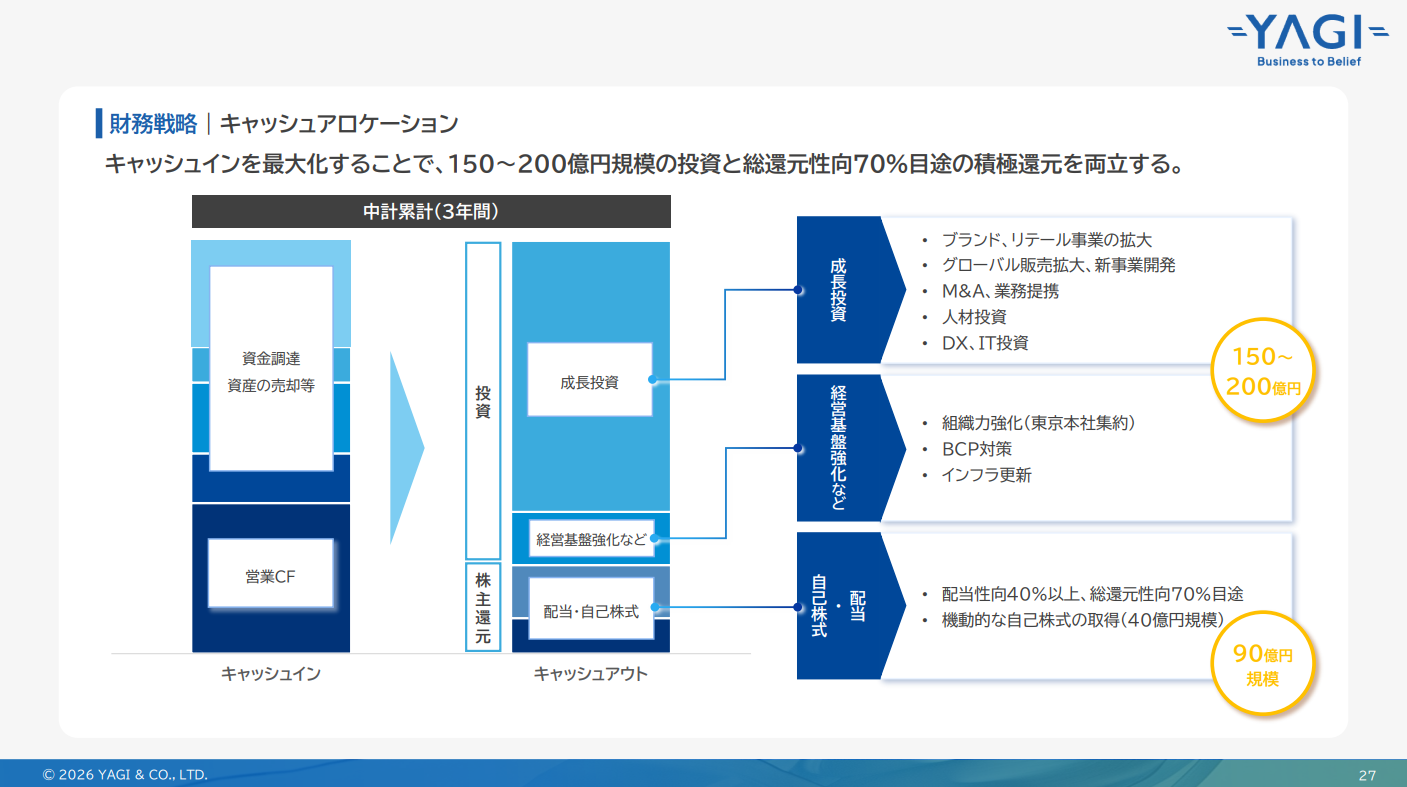
The second point is cash allocation (Figure 6). Although this repeats part of our first post, the plan clearly places substantial weight on JPY 15.0-20.0 billion of growth investment on the cash-out side. On the cash-in side, although no concrete numeric figures are stated, the area representing funding through asset disposals and other sources is more than twice the size of its operating cash flow over the 3 year period. This is precisely the part of the plan that envisages a recycling of value grounded in an awareness of the Company’s intrinsic value. We understand that asset values fluctuate with macroeconomic conditions and may therefore be difficult to express as fixed amounts. Even so, a medium-term plan that expresses capital recycling on this scale compared to operating cashflow is exceedingly rare. Here too, we see both management’s willingness to take the offensive and its resolve.
Figure 6: YAGI’s Cash Allocation (Japanese only)
(Source: YAGI MTP2029 presentation materials)
YAGI’s current President, Mr. Takao Yagi, is the sixth generation of the founding family and has served as President since 2016. He has described the Company as being “sensitive to changes in its environment, like an amoeba,” and has personally led numerous organizational restructurings, reforms, and acquisitions. Some of those acquisitions may have failed, but among them was the encounter with TATRAS, which has since grown into a pillar of the Brand Business. In a capitalist economy, risk and return are positively correlated. There is no way to realize intrinsic value and then increase it—to earn a decent return—without taking risk. Growing a business, however, requires calculated risk-taking. We believe it is plausible that YAGI and President Yagi possess a strong capacity for judging risk, developed through navigating the rise and decline of Japan’s textile industry and the powerful waves of change that have reshaped the textile value chain across Asia. The value of this management stance and capability is not captured in our quantitative intrinsic-value calculation. Indeed, their unmeasurable value may even be greater than the intrinsic value quantified above.
We would like to thank everyone who has followed this YAGI five-part series. As a shareholder committed to supporting the Company’s growth, and as a “close yet tough friend,” to YAGI, we will continue our constructive dialogue with the management in pursuit of maximizing shareholder value for all the shareholders.
¹ The intrinsic value discussed herein represents solely our view as an investor. We hope readers will use it only as a starting point for conducting their own independent research and due diligence.
(Past Posts)
23/Jul/ 2026- YAGI Series, Part 4: TATRAS’s Path to Winning
29/Jun/2026-Announcement of YAGI Co., Ltd. A Primer on the Down Jacket Market #3
9/Jun/2026 - YAGI: Large Shareholding Report and Company Introduction Materials
28/May/2026 - YAGI’s history and core strengths
14/May/2026 - Comment on YAGI’s Medium-Term Management Plan 2029
This post does not constitute a proposal, solicitation, marketing communication, advertisement, inducement or representation in respect of any service or product, nor does it constitute advice to buy or sell any investment product or any investment of any kind, or a recommendation to purchase or sell any investment product, make any investment, execute any transaction, or refrain from taking any other action, whether or not any terms are described.
This post presents our views and estimates concerning Yagi & Co., Ltd. (“Yagi”), its businesses and the value of its securities. It does not, however, recommend the purchase, sale or holding of YAGI or any other security and is not intended to be relied upon for any individual investment decision. The valuations in this post are our own estimates based on specified assumptions and do not guarantee any future share price, performance or realisation of value. Any examples of strategies or transactions are provided solely for illustrative purposes and do not indicate any past or future strategy or performance, nor do they indicate the likelihood of success of any particular strategy. This post does not constitute investment, financial, legal, tax, or any other advice.
This post presents our assessments, estimates, and opinions regarding the business of Yagi and Yagi group companies.
This post has been prepared based on publicly available information, which we have not independently verified, and is not complete, timely, or comprehensive.
Although we believe that the information contained in this post is accurate and reliable, we make no representation or warranty as to the accuracy, completeness, or reliability of such information, or of any statements or oral communications regarding Yagi, Yagi group companies, or any other companies described herein. We also assume no responsibility for any such statements or communications, including any inaccuracies or omissions therein. With respect to public companies, there may be non-public information held by such companies or their insiders that has not been disclosed by those companies. Accordingly, all information contained in this post is presented “as is,” without any warranty of any kind, and we make no express or implied representation as to the accuracy, completeness, or timeliness of such information, or the results of its use. Readers should obtain their own professional advice and make their own assessment of the relevant matters. We disclaim no obligation or liability for any loss arising from, or in connection with, the use of all or any part of the information contained in this post, including any inaccuracies or omissions therein. Any investment involves significant risks, including the risk of a complete loss of capital. Any forecasts or estimates are provided solely for illustrative purposes and should not be regarded as indicating any upper limit of potential gains or losses. We may modify all or part of this post without notice to any person, but we are under no obligation to provide any revisions, updates, additional information or materials in relation to this post, or to correct any inaccuracies.
This post may contain content or quotations from, or hyperlinks to, publicly available third-party sources of information (“Third-Party Materials”). Permission to quote Third-Party Materials in this post may not have been sought or obtained. The contents of Third-Party Materials have not been independently verified by us and do not necessarily reflect our views. The authors and/or publishers of Third-Party Materials are independent from us and may hold views that differ from ours. The inclusion of Third-Party Materials in this post does not imply that we endorse or agree with any part of the content of such Third-Party Materials, nor does it imply that the authors or publishers of such Third-Party Materials endorse or agree with the views expressed by us in relation to the relevant matters. Third-Party Materials do not constitute all relevant news reports or views expressed by third parties regarding the matters discussed herein.
We do not intend, either by ourselves or through other shareholders, to propose at a general meeting of shareholders of Yagi that the business or assets of Yagi or Yagi group companies be transferred to a third party or discontinued. We also have no intention of engaging in any conduct whose purpose would be to make it difficult for Yagi or Yagi group companies to continue conducting their businesses in a stable and ongoing manner.
We currently beneficially own and/or have an economic interest in securities of Yagi and/or Yagi group companies, and may continue to beneficially own or have an economic interest in such securities in the future. With respect to our investment in Yagi and/or Yagi group companies, we may, on an ongoing basis and depending on various factors — including the financial condition and strategic direction of Yagi and Yagi group companies, the results of discussions with Yagi and Yagi group companies, overall market conditions, other investment opportunities available to us, and the possibility of purchasing or selling securities of Yagi and Yagi group companies at prices at which we desire to transact — at any time, including through open-market or private transactions after we have established a position, buy, sell, cover, hedge, or otherwise change the form or substance of our investment, including securities of Yagi and Yagi group companies, in any manner permitted by applicable laws and regulations, and we expressly disclaim any obligation to notify others of any such changes. We reserve the right to take any actions we deem appropriate in relation to our investment in Yagi and Yagi group companies. Such actions may include, but are not limited to, communications with the board of directors, management, or other investors.