
On May 11, 2026, YAGI Co., Ltd. (securities code: 7460; hereinafter the “Company” or “YAGI”), one of the core portfolio companies of Hibiki Path Advisors SPC (“Hibiki,” “we,” or “our”), announced its new medium-term management plan, Medium-Term Management Plan 2029 (Business to Belief). While continuing to derive its fundamental source of added value from the wide range of materials and fashion-trend insights accumulated through its long-standing global textile trading business, its original core business, YAGI is now decisively shifting its course toward pursuing growth on a new global stage through proactive investment as a brand-driven company. In Part 3 of this series, we reviewed the size and growth trajectory of the global down jacket market and introduced the strategies of Canada Goose and Moncler, two leading players that have helped drive the market’s evolution toward luxury. In this fourth installment of our five-part series introducing YAGI, we consider, from an external perspective, “TATRAS’s path to winning” — core driver for YAGI’s growth strategy.
Core Line – TATRAS DOMIZIANO
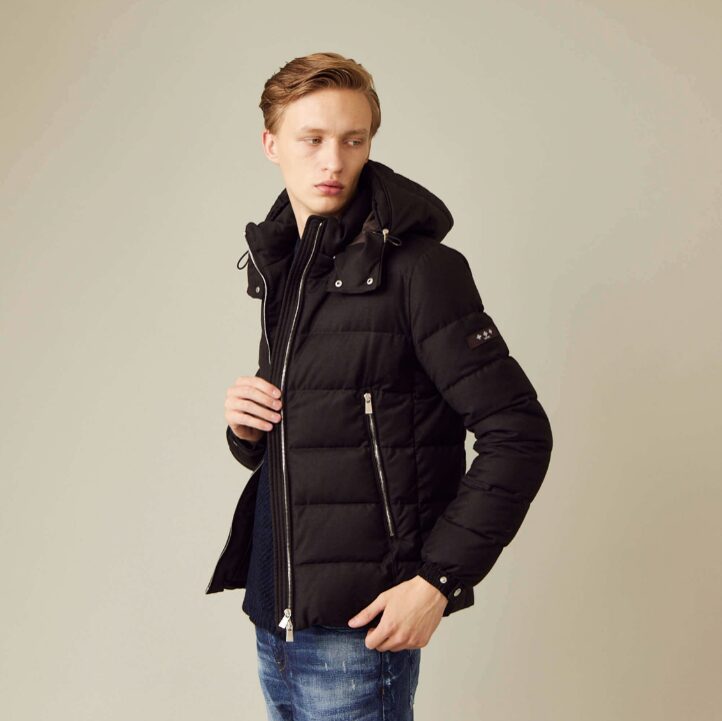
(Source: HV Blog)
To recap our previous post, Canada Goose and Moncler, both competing at the very top end of the market, shared four important characteristics: (1) their products were of inherently high quality from the outset; (2) they preserved owner-led leadership and a strong commitment to the brand; (3) they avoided indiscriminately expanding across numerous brands and instead pursued a focused strategy of maximizing the value of the original brand; and (4) at critical moments, they made effective use of private equity expertise and capital to accelerate growth. What, then, are TATRAS’s distinctive characteristics as we see them from an independent perspective? We would summarize them as follows.
・TATRAS achieves a carefully judged balance through the combination of three elements: Japanese refinement and meticulous attention to detail; Italian design sensibility; and the finest-quality white goose down sourced from Poland, a country known for its severe winters. The three crosses in its logo—representing “elegance,” “practicality,” and “exclusivity”—similarly evoke the ideal balance expected of an exceptional product: an almost Apollonian harmony.
・Although TATRAS is a relatively young brand, established in 2007, YAGI’s acquisition of management control has increasingly connected it with the 130-year heritage of YAGI, its hospitality and devotion to customers embodied in the corporate motto “Sincerity from Start to Finish,” and the traditions of Japanese history and culture. This is beginning to give greater depth to the TATRAS brand story, although the transformation remains a work in progress.
Figure: TATRAS Brand Positioning
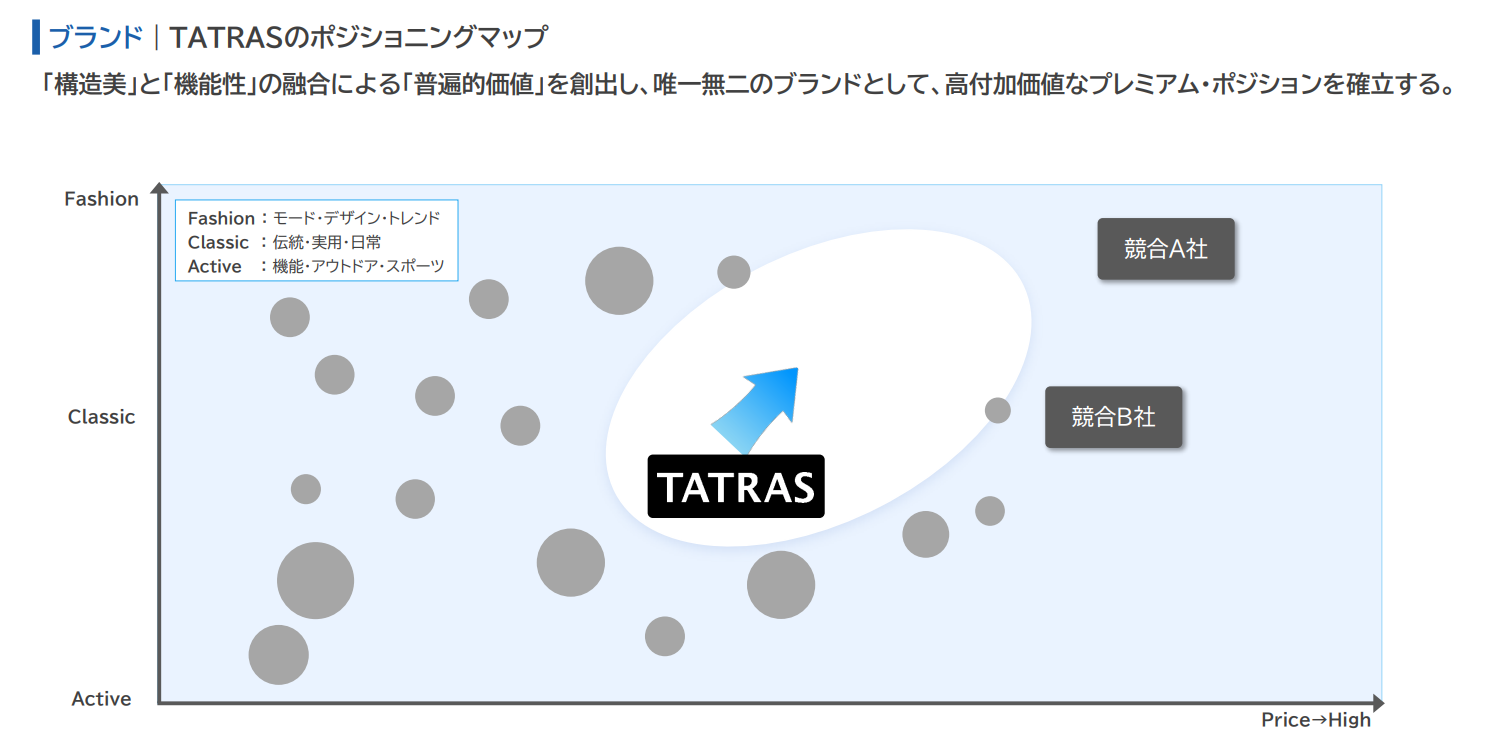
(Source: Yagi MTP 2029)
“TATRAS’s Path to Winning”
While we make no claim to be marketing experts, we have invested in many consumer goods and branded-product manufacturers over the years and would like to share a few concise observations. These are not intended as a hands-on prescription for what TATRAS should become. Rather, from a consumer’s perspective, they are strategic lenses through which we believe TATRAS should continue to examine its challenges—many of which may already be under active discussion internally. We believe that clearly organizing the following issues, executing against them, and continuously running a plan-do-check-act cycle to assess their impact would provide a sound foundation for success over the long journey ahead.
1. Articulate TATRAS’s positioning, world view, and philosophy.
2. Create a measured cadence of initiatives that express and propagate TATRAS’s immersive world—neither too many nor too few.
3. Exercise precise control over digital marketing and branding/sales strategy.
4. Define clear tactics for younger consumers, particularly Generation Z and Millennials.
The first point—articulating what TATRAS stands for—is hardly a novel observation; it is the essential starting point for any brand business. We emphasize it because a strong “root system” and “backbone” are indispensable if a brand is to earn global recognition. The process of repeatedly asking fundamental questions—”Who are we?” “What do consumers value in us?” “Which consumers embrace us?” “What is our mission?” and “What makes us different?”—and translating the answers into words, supported by rigorous market research, is never easy. TATRAS, like its peers, is now competing to reduce dependence on winter products and become an all-season brand. Given its premium price points, its products are not casual impulse purchases. We believe that emotional identification with the brand’s world view is therefore the most important hook. Ultimately, a brand’s “world view” is its very essence.
Burberry, for example, is a storied brand founded in 1856 renowned for its trench coats. Its brand value suffered a significant decline after 2000, and it is well known that, under Angela Ahrendts, who became CEO in 2006, the Company returned to first principles and embarked on a process of rediscovering “who we are.” While closing numerous product lines and implementing a broad restructuring, she identified Burberry’s essence and returned the brand concept to a 100% focus on the quality of its coats—the foundation of its authenticity. One image used in that process, shown below, depicts Sir Ernest Shackleton’s 1914-1917 polar expedition. Wearing Burberry coats, the expedition members survived severe cold, the wreck of their ship, and other extraordinary hardships before returning home. By rediscovering this icon, Burberry renewed awareness of quality, reassurance, and brand value, leading to a dramatic resurgence in growth.
Figure: Sir Shackleton expedition wearing Burberry

(Source: Medium)
In Japan, MUJI’s transformation in 2003 is particularly instructive—back when the brand was still referred to as Mujirushi Ryohin. Previously, consumers generally associated it with minimalist packaging and design, simplicity, and reasonably good quality (below left). Designer Kenya Hara deliberately connected the underlying simplicity and emptiness of the brand with the philosophy of Zen (below right). This allowed the quiet, beautiful world view that had long lain beneath the surface of the brand to reach consumers globally. The shift enhanced brand value, supported higher unit prices, and established a distinctively MUJI identity that continues to evolve today.
Figure: Earlier MUJI products and the 2003 brand poster

(Source: MUJI website)
MUJI has consistently reinforced an identity built around spiritual richness within minimalism, using phrases such as “There is everything in emptiness” and “Like Water, Like Air.” It is widely regarded as a compelling example of how Japanese sensibility and understated elegance can be expressed through branding.
Recent developments at YAGI’s TATRAS suggest a similar effort and a more evolved direction than before. The link below offers a glimpse of this emerging world view. The initiative integrates the technique and spirit of “bokashi” gradation used in Wajima lacquerware, a traditional craft of Japan’s Hokuriku region, into the world of TATRAS. Traditional Japanese craftsmanship and TATRAS’s stylish design are brought together beautifully in a form that feels both old and new.
ABOUT THE “Layers of Japanese Craft” PROJECT – ART DIRECTED BY YOSHIRO
Experiments with this somewhat new form of expression are also taking place overseas. With the initial emphasis on communicating the brand’s world view rather than simply driving sales, the Spring/Summer 2027 collection has been presented in Paris since June of this year (see the link below).
The Way of the Sea – Spring / Summer 2027 Paris Presentation
White sand and stones evoke a Japanese rock garden within an urban setting, while also suggesting the seashore and the natural world. Japanese inspiration appears to be woven into the presentation in an understated manner. At a time when Japanese culture is being rediscovered and reassessed globally, we see nothing inappropriate in gradually incorporating YAGI’s long history and Japanese values, provided this is done without obscuring the qualities that make TATRAS distinctive. In any event, to support strong future growth, we hope TATRAS will define its foundational world view with renewed clarity and organize and communicate it in a manner that capital-market participants such as ourselves can readily understand.
The initiatives introduced through the links above sit precisely at the intersection of the second and third elements of the path to winning: events that communicate the brand’s world view, and the marketing and sales strategy that carries it to consumers. In a world overflowing with information, brands need to create opportunities—at an appropriate cadence—to express their opinions and world view, identify those who resonate with them, and strike an emotional chord. One might compare this to Barcelona’s Sagrada Família: over an almost timeless horizon, its world is painstakingly constructed upward and outward, and milestones such as the completion of individual towers become major global events. Each newly added structure then reinforces the essence of the whole in a self-reinforcing process.
As customer touchpoints have rapidly become digital, digital strategy is now one of the most important marketing priorities even for luxury brands. Rather than maintaining the light-touch, constant mental presence more appropriate for a mass-market brand, TATRAS will likely need powerful and consistent marketing that uses influencers and fashion icons capable of deepening or elevating its world view, striking a lasting impression in the viewer’s memory. In the physical realm, TATRAS has recently continued an ambitious program of flagship-store openings in Japan. These stores are indeed effective in allowing the brand to control its narrative carefully and appeal to the emotions of consumers whose interest has already been engaged.
Figure: Illustrative customer journey and touchpoints
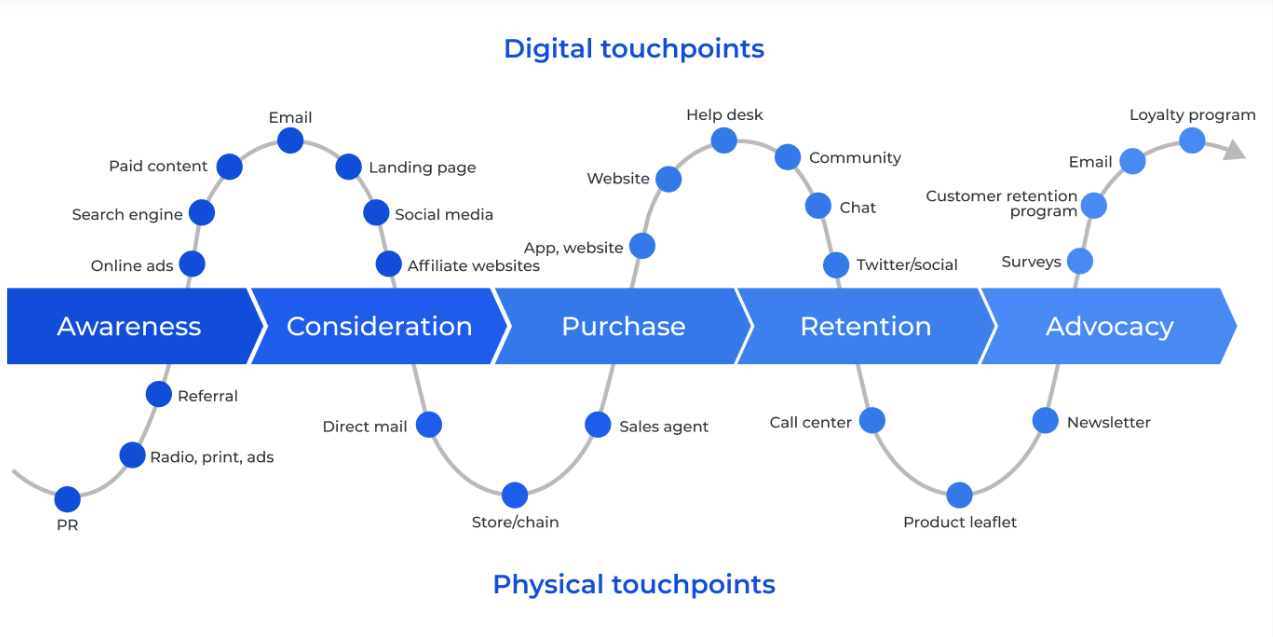
(Source: Viden website)
As the figure above illustrates, digitalization has made the customer journey from awareness to purchase more complex and longer, while shifting many of the touchpoints leading to a purchase online. This has made the propagation and control of a brand’s world view more difficult in some respects, but easier in others. In fact, where the brand message is already bold and clear, digitalization can be made to work to the brand’s advantage. This marketing context will only accelerate. One example—whether for better or worse—is the LYST Index, a service that aggregates a wide range of digital and physical-world data to rank luxury brands quarterly according to their current level of consumer interest. We now live in a world where competition in digital marketing itself is becoming gamified.
For TATRAS, we believe the path to sustaining and enhancing brand value over the medium to long term is to avoid gimmicks, establish a strong backbone and a clear image of the brand, conduct fully controlled brand marketing, and retain a firm grip on product supply through a primarily DTC model. The same discipline is required when expanding into spring and summer products. Because maintaining brand value requires an emphasis on high-quality, premium-priced merchandise, an expansion driven simply by the supplier-side desire to increase sales carries a substantial risk that customers will not follow the proposed price points. Summer, perhaps even more than winter, requires the kind of strong brand loyalty that makes customers think, “When I want to feel a little special, I will put on TATRAS and head into the city.” We therefore believe the down jacket should remain the hero product—the icon that first draws customers in—and that the brand’s world view should be woven outward around it, stitch by stitch.
The fourth element—defining clear tactics for the younger generation—is by no means unique to TATRAS; it is arguably the most critical challenge facing anyone seeking to build a brand business today. The cohort spanning roughly from their twenties to early forties is either in the process of acquiring purchasing power or has already done so, and will exert a decisive influence on the durability and long-term value of any brand franchise. This generation is digitally native, and, in particular, those residing in Europe and the United States are often described as having a strong awareness of social justice and rightfulness. Paradoxically, it is precisely among such consumers that authenticity—whether in products or experiences—can resonate most deeply. At the same time, because their lifestyles and life philosophies have become extremely diverse, the difficulty of identifying, within the vast digital space and from a truly global perspective, those audiences most likely to empathize with a given brand should not be underestimated. It is essential to remain constantly alert to opportunities to create such hooks, and this may well be an area in which TATRAS ought to partner closely with specialist external experts or agencies. In any event, we believe this is far too important a field for TATRAS to adopt a stance of “doing nothing for now” and postponing preparatory steps to some undefined future.
―――――――――――――――
TATRAS joined the YAGI Group in 2014 and has since grown remarkably. Today, WEAVA, the YAGI subsidiary that primarily handles TATRAS, generates sales of JPY 12.2 bn and recurring profit of JPY 2.1 bn (see figure below). These profits now account for more than 40% of YAGI’s consolidated recurring profit of JPY 4.8 bn in FY3/26.
Figure: Sales and profit trends of subsidiary WEAVA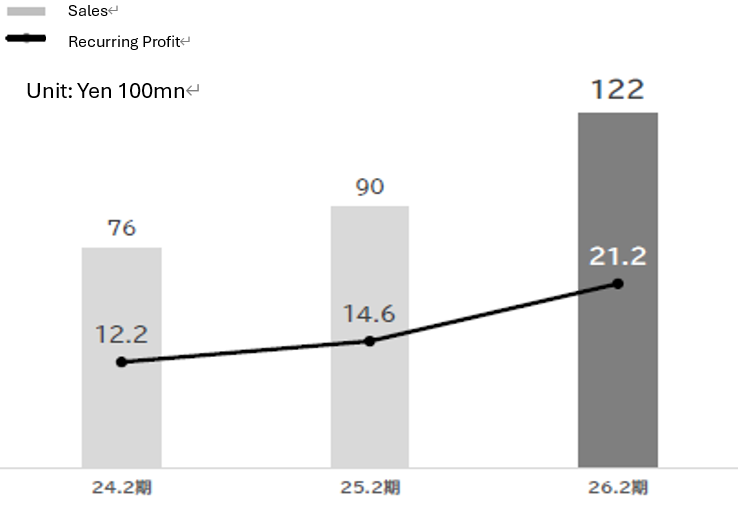
(Source: YAGI, IR material 4Q FY3/26)
TATRAS is currently on a steep upward trajectory, and the number of its key domestic stores has now exceeded twenty. Inbound customers have increased, and brand awareness is rising. That said, the current medium-term plan does not yet assume a major overseas rollout; rather, the focus for now is on building recognition through initiatives such as pop-up stores and event-linked promotions. We believe the orthodox path to becoming a truly global luxury brand is to give full expression to a world view that can stand on the global stage, to pursue targeted marketing activities for affluent tourists in a way that also deepens recognition among inbound customers, and thereby to lay a robust foundation for TATRAS as a genuine global luxury brand. As shareholders, we are very much looking forward to TATRAS’s continued growth along this path.
Our fifth and final installment in this series on YAGI will return to the fundamentals of equity investing and value analysis. Having discussed YAGI’s new medium-term plan, its history, industry context, and brand strategy from multiple angles, we will conclude by explaining how we, as investors, view YAGI’s intrinsic value. Stay tuned!
(Past Posts)
29/Jun/2026-Announcement of YAGI Co., Ltd. A Primer on the Down Jacket Market #3
9/Jun/2026 - YAGI: Large Shareholding Report and Company Introduction Materials
28/May/2026 - YAGI’s history and core strengths
14/May/2026 - Comment on YAGI’s Medium-Term Management Plan 2029
This post does not constitute a proposal, solicitation, marketing communication, advertisement, inducement or representation in respect of any service or product, nor does it constitute advice to buy or sell any investment product or any investment of any kind, or a recommendation to purchase or sell any investment product, make any investment, execute any transaction, or refrain from taking any other action, whether or not any terms are described. It also does not constitute an opinion regarding the merits of any particular investment or investment strategy. Any examples of strategies or transactions are provided solely for illustrative purposes and do not indicate any past or future strategy or performance, nor do they indicate the likelihood of success of any particular strategy. This post does not constitute investment, financial, legal, tax, or any other advice.
This post presents our assessments, estimates, and opinions regarding the business of Yagi & Co., Ltd. (“Yagi”) and Yagi group companies.
This post has been prepared based on publicly available information, which we have not independently verified, and is not complete, timely, or comprehensive.
Although we believe that the information contained in this post is accurate and reliable, we make no representation or warranty as to the accuracy, completeness, or reliability of such information, or of any statements or oral communications regarding Yagi, Yagi group companies, or any other companies described herein. We also assume no responsibility for any such statements or communications, including any inaccuracies or omissions therein. With respect to public companies, there may be non-public information held by such companies or their insiders that has not been disclosed by those companies. Accordingly, all information contained in this post is presented “as is,” without any warranty of any kind, and we make no express or implied representation as to the accuracy, completeness, or timeliness of such information, or the results of its use. Readers should obtain their own professional advice and make their own assessment of the relevant matters. We disclaim no obligation or liability for any loss arising from, or in connection with, the use of all or any part of the information contained in this post, including any inaccuracies or omissions therein. Any investment involves significant risks, including the risk of a complete loss of capital. Any forecasts or estimates are provided solely for illustrative purposes and should not be regarded as indicating any upper limit of potential gains or losses. We may modify all or part of this post without notice to any person, but we are under no obligation to provide any revisions, updates, additional information or materials in relation to this post, or to correct any inaccuracies.
This post may contain content or quotations from, or hyperlinks to, publicly available third-party sources of information (“Third-Party Materials”). Permission to quote Third-Party Materials in this post may not have been sought or obtained. The contents of Third-Party Materials have not been independently verified by us and do not necessarily reflect our views. The authors and/or publishers of Third-Party Materials are independent from us and may hold views that differ from ours. The inclusion of Third-Party Materials in this post does not imply that we endorse or agree with any part of the content of such Third-Party Materials, nor does it imply that the authors or publishers of such Third-Party Materials endorse or agree with the views expressed by us in relation to the relevant matters. Third-Party Materials do not constitute all relevant news reports or views expressed by third parties regarding the matters discussed herein.
We do not intend, either by ourselves or through other shareholders, to propose at a general meeting of shareholders of Yagi that the business or assets of Yagi or Yagi group companies be transferred to a third party or discontinued. We also have no intention of engaging in any conduct whose purpose would be to make it difficult for Yagi or Yagi group companies to continue conducting their businesses in a stable and ongoing manner.
We currently beneficially own and/or have an economic interest in securities of Yagi and/or Yagi group companies, and may continue to beneficially own or have an economic interest in such securities in the future. With respect to our investment in Yagi and/or Yagi group companies, we may, on an ongoing basis and depending on various factors — including the financial condition and strategic direction of Yagi and Yagi group companies, the results of discussions with Yagi and Yagi group companies, overall market conditions, other investment opportunities available to us, and the possibility of purchasing or selling securities of Yagi and Yagi group companies at prices at which we desire to transact — at any time, including through open-market or private transactions after we have established a position, buy, sell, cover, hedge, or otherwise change the form or substance of our investment, including securities of Yagi and Yagi group companies, in any manner permitted by applicable laws and regulations, and we expressly disclaim any obligation to notify others of any such changes. We reserve the right to take any actions we deem appropriate in relation to our investment in Yagi and Yagi group companies. Such actions may include, but are not limited to, communications with the board of directors, management, or other investors.