
In September 2026, Hibiki Path Advisors SPC (“we,” “us,” or “Hibiki”) had the opportunity to visit the Odaka and Haramachi factories of Fujikura Composites Inc. (TSE: 5121; the “Company” or “Fujikura Composites”), one of our core portfolio companies, and the visit left a strong impression on us. As we walked through the production sites and saw the people working there firsthand, we could not help but think about the history of the Odaka Factory, which resumed operations after being affected by the Great East Japan Earthquake. Earnings materials and management meetings are, of course, important, but some of a company’s strengths cannot be fully understood through numbers or words alone. This visit gave us a much more tangible sense of where Fujikura Composites’ value really comes from.
During the tour, we saw production processes for parts used in control equipment and automotive components, as well as the manufacturing process for sporting goods. What stood out to us was that many products are made in relatively small volumes, with specifications that differ from product to product, rather than being mass-produced by machines on standardized lines. Human hands, eyes, judgment, and experience still matter a great deal, and in that sense, the factories felt to us like places where craftsmanship remains at the heart of production.
This was especially clear in the sporting goods business. Fujikura Composites has built up design and manufacturing know-how over more than 50 years, and we could clearly see how the skills of the people on the factory floor turn that know-how into real products. This combination is what supports the Company’s competitiveness today. Another strength is that testing and evaluation are located very close to manufacturing, allowing the Company to quickly repeat the cycle of “make, test, and improve.” We believe this fast feedback loop is also an important source of strength in this business.
Figure: Robot testing a golf shaft
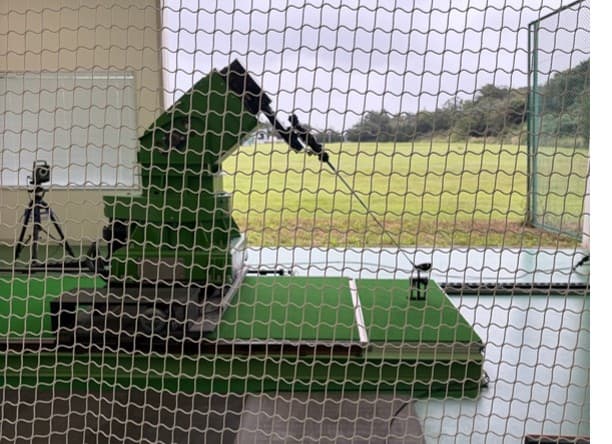
As investors, we usually look at the high profitability of the sporting goods business through numbers. But standing on the factory floor this time, what we felt was that a process that may look simple — selecting materials, layering, winding, curing, sanding, and painting — actually contains craftsmanship and know-how that are very difficult to automate, and that this process is one of the true sources of product differentiation. Fujikura Composites has combined these manufacturing capabilities with many years of accumulated swing and impact data from players, and has continued to improve its products day by day. Seeing the process firsthand made us realize again how long the journey behind the FUJIKURA brand has been. This long accumulation of data, skill, trial and error, and constant refinement is, in our view, one of the reasons why the brand has earned such strong recognition from customers.
For technically demanding shafts weighing less than 40 grams, Fujikura Composites has introduced a skill certification system for “meister” craftsmen in the winding process, while also working to pass these skills on to younger generations. The Company is also trying to use automation and DX where possible, but what became clear to us on the factory floor is that automation is not as simple as it may look from the outside. Even in processes that appear repetitive, final quality still depends on subtle human judgment, including where to draw the line between what is acceptable and what is not. We were struck by a candid comment from someone on the factory floor that “the road is still long.” Passing down skills, using machines where machines can help, and continuing to improve quality, technology, and cost competitiveness day by day may not look dramatic from the outside, but we felt that this steady accumulation is exactly where the real strength of Japanese manufacturing often resides.
In our previous post, “Fujikura Composites: FY3/26 Results, A Closer Look at the Growth Drivers of Its Golf Shaft Business” we wrote that one reason behind the Company’s current success may be its evolution from an OEM manufacturer into a brand owner with direct customer touchpoints, supported by brand strength, pricing power, and a mechanism for feeding customer feedback back into product development in the highly profitable custom and aftermarket segments. After visiting the factories, we also felt that the division of roles is clear: Japan serves as the source of production technology, and those technologies are then deployed to overseas production sites to improve profitability. There also appears to be remaining capacity at overseas sites. In our view, the foundation for further growth is already in place.
At the same time, the area where our expectations grew even further through this visit was the control equipment field, especially semiconductor-related applications. For products such as vibration isolation tables, we heard how the Company’s proprietary design and processing technologies, built over many years, have been recognized by customers and have led to actual business opportunities. Here, we could begin to see a winning formula that exists precisely because this is Fujikura Composites. As semiconductor manufacturing becomes more advanced and equipment becomes larger, the required level of design and performance is also rising. This seems to be expanding the areas where the Company’s technologies can be used, and inquiries also appear to be increasing. The new production space established through the large-scale capital investment in FY3/25 still has ample room, which suggested to us the Company’s confidence in future order growth. This is an area we would like to continue watching with great interest.
For the other industrial materials businesses, one important question is how the Company can further sharpen what makes Fujikura Composites distinctive. We could clearly feel that the teams at the factories are working through trial and error to find new applications for the Company’s long-accumulated material processing technologies. At the same time, technology only becomes real business value when customers recognize it, understand it, and are willing to pay for it. That is when technical strength becomes the foundation for sustainable growth.
This is where management matters. The Company already has a deep base of technology. It also has a number of possible business domains where that technology could be applied. The question is where Fujikura Composites can truly tell, “This is an area where we will not lose to anyone.” If the Company can carefully identify and nurture such areas, a new pillar could eventually emerge after the already strong sporting goods business and the semiconductor-related business, where the path to growth is becoming increasingly visible.
Through this visit, we became convinced that the Company’s on-site capabilities are extremely strong, and in no way inferior to those of many other Japanese manufacturers. At the same time, we were reminded that on-site strength alone is not enough. One important role of management is to connect that strength to a business portfolio that can continue to grow, compete, and create value over time. We hope management will continue to have the resolve to make decisions with the Company’s long-term future in mind — patiently nurturing businesses that should be nurtured, while also having the judgment to withdraw where it is necessary. To wait is important. But so is the courage to decide.
The factory tour was very well attended, with around 10 investment firms and just under 20 investors participating, including ourselves. During the tour, participants actively asked questions of the people in charge of each business and the director who accompanied us. There was lively discussion between the Company and investors on topics including capital investment, human resources, the competitiveness of each business, and future growth.
In our 2024 disclosure, “Merits and Challenges of Being Publicly Listed in the Era of Unsolicited Takeovers” we argued that one of the essential meanings of being listed is to build a healthy relationship with the capital market. At its core, a company receives recognition from society and turns that recognition into profit and long-term corporate value, with the well-being of employees naturally belonging within that process. This recognition takes two important forms: recognition from customers becomes the foundation for excess profit, or earnings, while recognition from shareholders supports corporate value, which is ultimately reflected in the capital market over time. Through this factory tour, we were able to see the starting point of Fujikura Composites’ recognition from customers — something we do not usually have the opportunity to observe — and for us as shareholders, this was a valuable experience. Activities that go beyond ordinary IR are undoubtedly demanding for companies, requiring time, preparation, and patience from many people inside the organization, but they are also very important. They help investors understand not only what a company earns, but why it is able to earn, and what kind of people, skills, and culture support that value creation. In that sense, this factory tour was a meaningful opportunity to think again about what a healthy relationship between a company and the capital market should look like.
With the utmost respect for the technologies and corporate culture that the people on the front lines have built over many years, we will continue to support the further growth of Fujikura Composites as a “close yet tough friend.”
EOD
(Our History of Engagement)
6/Jul/2026 ― Fujikura Composites: Structural Reform and Capital Policy, The Road Ahead
17/June/2026 – FY3/26 Results, A Closer Look at the Growth Drivers of Its Golf Shaft Business
10/Jun/2026 – Revised Large Shareholding Report and Company Introduction Materials
2/Apr/2026 – Revised Large Shareholding Report
26/Jan/2026 – Large Shareholding Report
26/Dec/2025 – Fujikura Composites’ Share Repurchase Announcement
5/Dec/2025 – Comments on Fujikura Composites 2Q Earnings Briefing
14/Nov/2025 – Submission of Our Proposal for Fujikura Composites
The views expressed in this post reflect our opinions and observations regarding Fujikura Composites Inc. (“FUJIKURA COMPOSITES”)’s business and corporate value; however, this post is not intended as, and does not constitute, a proposal, solicitation, marketing communication or advertisement in respect of any service or product, nor does it constitute investment advice or a recommendation to any person to acquire, hold or sell FUJIKURA COMPOSITES’ shares or any other investment product, make any particular investment, pursue any investment strategy, execute any transaction, or refrain from taking any such action. Any examples of strategies or transactions are provided solely for illustrative purposes and do not indicate any past or future strategy or performance, nor do they indicate the likelihood of success of any particular strategy. This post does not constitute investment, financial, legal, tax, or any other advice.
This post presents our assessments, estimates, and opinions regarding the business of FUJIKURA COMPOSITES and FUJIKURA COMPOSITES group companies.
This post has been prepared based on publicly available information, which we have not independently verified, and information obtained during the factory visit, and does not purport to be complete, timely, or comprehensive.
Although we believe that the information contained in this post is accurate and reliable, we make no representation or warranty as to the accuracy, completeness, or reliability of such information, or of any statements or oral communications regarding FUJIKURA COMPOSITES, FUJIKURA COMPOSITES group companies, or any other companies described herein. We also assume no responsibility for any such statements or communications, including any inaccuracies or omissions therein. With respect to public companies, there may be non-public information held by such companies or their insiders that has not been disclosed by those companies. Accordingly, all information contained in this post is presented “as is,” without any warranty of any kind, and we make no express or implied representation as to the accuracy, completeness, or timeliness of such information, or the results of its use. Readers should obtain their own professional advice and make their own assessment of the relevant matters. We disclaim any obligation or liability for any loss arising from, or in connection with, the use of all or any part of the information contained in this post, including any inaccuracies or omissions therein. Any investment involves significant risks, including the risk of a complete loss of capital. Any forecasts or estimates are provided solely for illustrative purposes and should not be regarded as indicating any upper limit of potential gains or losses. We may modify all or part of this post without notice to any person, but we are under no obligation to provide any revisions, updates, additional information or materials in relation to this post, or to correct any inaccuracies.
This post may contain content or quotations from, or hyperlinks to, publicly available third-party sources of information (“Third-Party Materials”). Permission to quote Third-Party Materials in this post may not have been sought or obtained. The contents of Third-Party Materials have not been independently verified by us and do not necessarily reflect our views. The authors and/or publishers of Third-Party Materials are independent from us and may hold views that differ from ours. The inclusion of Third-Party Materials in this post does not imply that we endorse or agree with any part of the content of such Third-Party Materials, nor does it imply that the authors or publishers of such Third-Party Materials endorse or agree with the views expressed by us in relation to the relevant matters. Third-Party Materials do not constitute all relevant news reports or views expressed by third parties regarding the matters discussed herein.
We do not intend, either by ourselves or through other shareholders, to propose at a general meeting of shareholders of FUJIKURA COMPOSITES that the business or assets of FUJIKURA COMPOSITES or FUJIKURA COMPOSITES group companies be transferred to a third party or discontinued. We also have no intention of engaging in any conduct whose purpose would be to make it difficult for FUJIKURA COMPOSITES or FUJIKURA COMPOSITES group companies to continue conducting their businesses in a stable and ongoing manner.
We currently beneficially own and/or have an economic interest in securities of FUJIKURA COMPOSITES and/or FUJIKURA COMPOSITES group companies, and may continue to beneficially own or have an economic interest in such securities in the future. With respect to our investment in FUJIKURA COMPOSITES and/or FUJIKURA COMPOSITES group companies, we may, on an ongoing basis and depending on various factors — including the financial condition and strategic direction of FUJIKURA COMPOSITES and FUJIKURA COMPOSITES group companies, the results of discussions with FUJIKURA COMPOSITES and FUJIKURA COMPOSITES group companies, overall market conditions, other investment opportunities available to us, and the possibility of purchasing or selling securities of FUJIKURA COMPOSITES and FUJIKURA COMPOSITES group companies at prices at which we desire to transact — at any time, including through open-market or private transactions after we have established a position, buy, sell, cover, hedge, or otherwise change the form or substance of our investment, including securities of FUJIKURA COMPOSITES and FUJIKURA COMPOSITES group companies, in any manner permitted by applicable laws and regulations, and we expressly disclaim any obligation to notify others of any such changes. We reserve the right to take any actions we deem appropriate in relation to our investment in FUJIKURA COMPOSITES and FUJIKURA COMPOSITES group companies. Such actions may include, but are not limited to, communications with the board of directors, management, or other investors.