
Dear all at our portfolio companies, Happy New Year.
This is Yuya Shimizu from Hibiki. I look forward to working with you again this year. Last year began with COVID-19 and ended with COVID-19. It was truly a difficult year, but at the same time, it was also a year that gave us many critical lessons. I believe this year will be an important one in which we overcome those challenges, turn what we learned through that hardship into strength, and make a real leap forward. We have written a New Year letter like this to our portfolio companies every year, and this year marks the fifth time. More than five full years have now passed since Hibiki was founded, as of last November. Our team has finally come together, and I feel that, little by little, we are beginning to do the things we have long wanted to do. With renewed discipline, we will continue moving forward. I hope that we can get through these difficult times together with all of you, and I look forward to your continued support.
In this letter, I would like to share how I personally see the world after COVID-19. Our New Year letters have been getting rather long every year, and this time, because there are several quite different messages I would like to convey, I have decided — perhaps rather passionately — to make this a three-part series. Today is the first part. I plan to send the second and third letters every two to three weeks. I realize this may be a lot to ask, but I would be grateful if you could bear with me and read them when time allows. If receiving physical letters is inconvenient, please contact us using the details on the enclosed business card, and from next time we will send them to you by email only.
On December 27, the day I started writing this letter, an interesting article appeared in the Nikkei. The title was “COVID-19 Accelerates Corporate Selection — P/B Gap Widens to 20-Year High” (attached). I thought it was a very good article for looking back at what happened in the stock market this year. Conceptually, price-to-book ratio, or P/B, compares a company’s book net assets with its share price, which represents the consensus view of a large number of market participants. It shows how much invisible added value — including intangible assets that do not appear on the balance sheet — is being added on top of book value, or conversely, how much the market is valuing the company below book value. P/B has a strong relationship with ROE, but it is also heavily influenced by changes in expectations.
The article described a harsh reality of polarization. In Japan, the U.S. and Europe, as equity markets rebounded sharply and continued to rise on the back of massive fiscal spending, the number of highly valued companies with P/Bs of more than 5x increased by 36% compared with the end of 2018. At the same time, however, the number of companies with P/Bs below 1x also increased by 6%.
The pandemic caused enormous inconvenience and forced people around the world to rely much more heavily on digital services. On top of that, the market environment also brought out one of capitalism’s most powerful features: the multiplier effect of expectations, both positive and negative. In this first letter, I would like to share my personal thoughts on the message that this market is sending us.
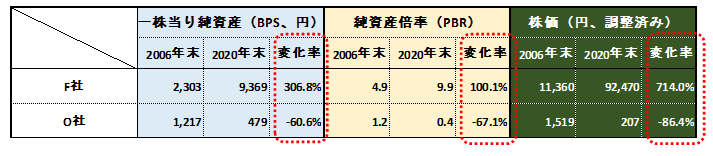
First, I revisited the comparison between Company O and Company F, which was also discussed in the article. Both are well-known companies in the same apparel industry — one a long-established company, the other a high-quality growth company. I looked at their book value per share, P/B, and share price over the 14 years since 2006, before the Global Financial Crisis. Neither company is one of our portfolio companies.
Company F vs. Company O: Changes in Key Metrics (2006–2020)
(Source: Hibiki, Bloomberg)
Looking at the share prices on the right, although the two companies are in the same industry, Company F’s share price rose roughly eightfold, while Company O’s share price fell by nearly 90%. Breaking this down, Company F increased its book value per share by more than 300%, or more than fourfold, while its P/B almost doubled from 4.9x to 9.9x. Company O, over the same period, saw its book value per share decline by more than 60%, while its market valuation, measured by P/B, fell from 1.2x to 0.4x, or to one-third of the original level. In terms of the actual change in net assets, the difference was about 370%, but once the change in P/B is added, the actual share price gap widened by as much as 800%.
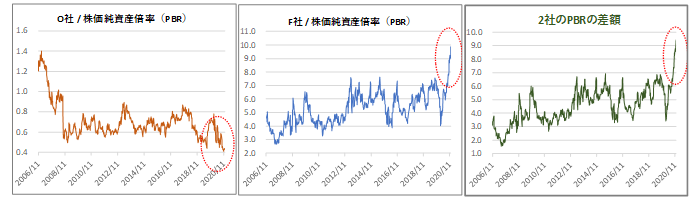
The following three charts show the movement in P/B over time.
(Source: Hibiki, Bloomberg)
The difference is already clear, but what is particularly interesting is that the gap widened even more sharply during the COVID-19 environment. The chart on the far right shows the difference in P/B between the two companies. We can see that the gap had been gradually widening, but that the change over the past year was especially abrupt. Why did such an astonishing difference emerge? The issue can be divided into two problems: management and expectations.
The first is, needless to say, the problem of management. As I wrote in our December 2019 letter on dividend on equity, or DOE, since the establishment of the Dutch East India Company in the 17th century — often said to be the first joint-stock company in history — book value per share, or BPS, has been used as a measure of management results. There is no doubt that it is one of the important subjects on a company’s report card. Whether BPS has increased or decreased over a certain period is an undeniable fact for management, and ROE is a simple way to measure the pace of that increase or decrease. Looking at the results, the difference between Company F and Company O is clear. When such a large difference appears within the same industry, we have no choice but to recognize it as a difference in management capability.
The second is the problem of expectations. When BPS declines over time, the market forms the expectation that, “if nothing changes, it will probably continue to decline.” Fortunately or unfortunately, human expectations tend to be almost linear extensions of the past. When BPS rises or falls, P/B often rises or falls on top of that movement. P/B is a strange thing: partly independent, partly dependent, and in many ways a reflection of changing expectations for ROE. This is the early stage of what I will later call the network effect. So I would like to separate the problem of management from the problem of expectations, and look at each a little more closely.
There is no need to explain at length how excellent Company F’s management has been. The more important question is how management should respond when a company is not in that position. To be honest, no one succeeds in every decision, and no one manages a company with the intention of destroying its capital. In that reality, what matters are three things. First, courage: the judgment and decisiveness to remove constraints, confront the essence of the problem, make the right decision even when it involves pain, and correct course quickly when a decision turns out to be wrong. Second, organizational capability: the ability to gather the management information needed to support those decisions and day-to-day corrections, and also to build an organization without blockages, where business goals and KPIs can be carried all the way to the front lines, with clear rewards and consequences. Third, creativity: creating a culture and atmosphere that does not reject innovation and reform, and that encourages employees to take initiative. Choosing the right KPIs that maximize corporate value over the long term, and then embedding them throughout the organization, is extremely difficult. There is a very interesting episode involving Alibaba and Ant Financial in China related to this topic, which I would like to introduce not in this letter, but in the second part.
The problem of expectations — in other words, P/B — is partly a problem that comes from a company’s actual track record, and partly a problem that involves the overall market. The part that comes from track record is easy to understand. It is the market’s appraisal that “this company is probably about this good,” for better or worse. That is a rational expectation in the sense that human behaviour does not change easily. What makes this more troublesome is that, with the development of AI, AI tends to reinforce and amplify the direction of market consensus.
AI makes predictions by repeatedly learning from past consensus data — in other words, past market reactions. The stronger AI becomes in the market, the more continuous “surprises” are needed to change the flow. I think the probability is high that AI will continue to take a larger role in markets going forward. As described in the attached article on P/B polarization, market participants and AI infer a company’s ability to respond to new issues such as digital transformation and ESG — which are derivative variables of management capability — from that company’s past performance. That image then reinforces itself and creates a multiplier effect. This effect accelerated dramatically during COVID-19 as digitalization moved forward at great speed. For convenience, I will call this the “network effect of expectations.”
Then what are the structural factors that create and expand this network effect of expectations at the root of the expectations problem? I believe there are three.
1. Excess money under low interest rates
2. The networking of money and investment behaviour itself
3. The networking of various business models themselves
First, when low interest rates flood the market with money, the blood of the market becomes thinner and circulates faster. COVID-19 then added further force to this, as capital investment shrank and money with nowhere to go gained even more momentum. We cannot avoid this phenomenon. The next two points, however, are not simply “because of COVID-19.” Rather, I think COVID-19 merely accelerated a fundamental structural transformation that was already taking place in the capitalist economy.
Behind the networking of money itself lies the life revolution in China brought about by Alibaba and Alipay, which I plan to discuss in the second part — a world where one’s life can almost be completed inside the smartphone screen. In the U.S. as well, the model offered by Robinhood, a fintech company said to have already become a unicorn with a pre-IPO valuation of over USD1bn, is revolutionary. With the rather grand mission of “democratizing the market,” Robinhood introduced the so-called freemium model into stock trading. It does not charge customers trading commissions, and instead earns money through routing orders to securities firms, margin transactions, and advertising revenue. It has already opened 13mn accounts, and half of those users are first-time stock investors. In that sense, it has opened up a completely new class of investors.
Founded in 2013, the company turns the investment behaviour accumulated inside the app into a kind of theatre, while monetizing the huge amount of order flow and data. It constantly shows information inside the app, such as which stocks are receiving many buy orders, and in many ways it also stirs up individual emotions. It even offers a service where users can receive “hot stocks” such as Google for free if they get friends to open accounts. In some sense, one cannot help feeling that this may have crossed a line. Although the company has recently received improvement orders from the Securities and Exchange Commission, it has certainly lowered the hurdle for stock investment dramatically. Perhaps we are finally reaching the climax of the “app-ification” of the securities market as a whole. I would like to talk more about this in the third part.
The third point, the networking of business models, of course did not begin today. The children of the Internet and social media era — the companies known as GAFA, or so-called platformers — have already been advancing rapidly for some time by using business models with near-zero marginal costs. That wave has already spread, and in many cases has no choice but to spread, to many different industries. With COVID-19, we have entered all at once into an era where a company’s ability to respond to this change, and the skill with which it responds, has a major impact on business performance and corporate value.
We can say “the networking of business models” in one phrase, but there are many different cases, and probably no two are exactly the same. The difference is clear between Company F, which responded to online sales and further improved its performance during COVID-19, and Company O, which struggled with its traditional relationships with department stores and other channels, and was slow to respond. There are also visible examples such as Sony, which is rapidly expanding a subscription model using PlayStation hardware as a hub, and Toyota and SoftBank, which are forming partnerships that cross industry boundaries. At the same time, there are less visible areas as well, such as how effectively companies can make internal DX — including remote work — function and create new added value. In that sense, the question is whether a company can creatively destroy existing frameworks such as “manufacturing” and “services,” or existing ways of working, and adapt them to the new era.
COVID-19, as an emergency, has exposed each company’s current position. Things that might otherwise have become visible only over several years have, fortunately in one sense, suddenly come to light — fortunately because, if companies respond with a proper sense of urgency, there may still be room to recover. There may be some temporary reversion, but in an age when data communication capacity will expand dramatically through 5G and 6G, we should regard this as a structural trend with no way back.
So far, I have tried to unpack what the current market is suggesting by dividing it into the problem of management and the problem of expectations. What we must not forget is the presence of machine learning, or AI, which sits underneath all of this like a basso continuo that never quite disappears. Simply put, AI is a method of allowing algorithms to improve autonomously and gradually through repeated learning from metadata. It is already being used on the front lines of many businesses and manufacturing sites. In securities markets as well, although unfortunately there is no precise data, it is said that more than 70–80% of orders flying through major markets are placed not by humans, but by programs called algorithms, albeit with varying levels of sophistication. Many financial institutions and funds are also increasingly applying AI. At Hibiki as well, more than 90% of our orders are executed by automated algorithms after we set certain conditions.
Let us stop and think again for a moment. I would be grateful if I could borrow the last five minutes of your busy minds. What makes AI so powerful is that it can instantly digest and analyse a massive amount of data that would take the human brain thousands of years to process. In the securities market, when it comes to individual companies, the process looks roughly as follows.
1. Collect company earnings results and press release information
2. Analyse the content of the information, including both numerical data and the nuance of written language
3. Confirm how the information spreads and ripples through news, chats, tweets and so on
4. Confirm the share price reaction over the short, medium and long term
You will probably notice immediately that, if we describe this in an analog way, it is an enormous accumulation of past case studies. It is a multi-axis pseudo-linear model that predicts consensus by saying, “people reacted this way in the past, so they will probably react this way again.” As AI becomes more present, and as finance itself becomes more networked, the market seems to lose its weight — perhaps it is already in a state of zero gravity — and the law of inertia becomes stronger.
By the law of inertia, I mean that past tendencies in the stock market and other market reactions do not calm down or fade away with time, but instead last longer and become stronger through repeated learning. In other words, for example, companies that have not been properly valued despite their efforts and results face a much higher risk of falling into the fallacy that, precisely because they have not been valued in the past, they will not be valued in the future either — at least according to AI’s prediction. There is no human will involved in this, which is frightening. To be honest, even for us, as fundamental investors who visit companies frequently, speak with management, and invest based on those conversations, this gives us complicated feelings. Of course, for a company like Company F, which has already established a positive image, it is easier to maintain that valuation simply by continuing to renew that positive image. On the other hand, once a company falls from that position, it takes enormous energy to climb back up.
A few years ago, when I wrote about facing the market, I raised the concern that we might reach a state where “the tail wags the head.” As described above, the problem of expectations has become even larger, and we are already deeply immersed in that environment before we fully realize it. Whether we like it or not, it is the responsibility of listed companies to face this situation with the same seriousness with which all of you face your daily businesses. If a company does not have the will to face it, then perhaps it should go private or be acquired. Passively facing this environment has no meaning; it is almost the same as not facing it at all. That is why I would very much like to face it actively together with you. For investors like us, who invest based on fundamentals — the intrinsic value of companies — this is also a large and painful issue, and it is one we must confront together with all of you.
AI is based on the recognition of text information and patterns that overflow in the world. The most familiar example is the order in which results appear in a Google search. The algorithm is not disclosed, but Internet advertising companies work desperately to understand its mechanism and push their clients higher in search rankings. In a sense, it is a cat-and-mouse game.
So, for example, if a company wants to change this pattern recognition in the securities market — in other words, the market’s expectations toward the company — what should it do? It needs to drive in a large wedge of surprise, again and again, almost to the point where the market can no longer ignore it. This cannot be a superficial measure. It must be fundamental, committed, and impactful enough. The global polarization in P/B clearly shows how strong the linear bias in expectations has become, and how self-reinforcing that bias now is.
It does not have to be with us. But companies need to engage sincerely with investors and financial institutions they trust, understand what kind of image or preconception the market has toward them, and if they are confident that the company’s current reality is different from that image, then they need to present facts to the market with conviction — facts that the market has not yet priced in.
For example, one of our long-standing portfolio companies is Company E. It is a precision plastic molding company, known by those who know it as an excellent company with globally recognized capabilities in areas such as diffusion lenses used in LED televisions and connector lenses used in 5G optical fiber communications. From six years ago until last year, the company had continuously repurchased its own shares, and as a result treasury shares equal to a very large 34.5% of shares outstanding remained on its balance sheet. Because treasury shares are excluded from calculations such as earnings per share in the financial statements, the numerical effect was already reflected. And because they could also be used for future M&A, cancelling them was not necessarily seen as a high-priority issue. Among investors, however, there was a concern that those shares might eventually be released into the market once the share price rose.
Then, on November 16, during the COVID-19 pandemic, the company suddenly announced that it would cancel 27.42% of its treasury shares, while also announcing an additional share repurchase of 4.19%. On November 30, it announced a further share repurchase of 4.35%. Then, on December 10, it went even further and announced a very large additional share repurchase of 13.59%. The messaging effect of this series of announcements was enormous. The market received it with real surprise. The share price rose from ¥2,197, the closing price on November 16 before the first announcement, to ¥3,900 at year-end — an increase of 77.5% in just one and a half months. In P/B terms, it rose from 0.54x to 0.97x. The part of the company that had been “priced poorly” was turned around from the ground up. The business itself had managed to hold firm during COVID-19 thanks to the desperate efforts of management and employees, and a recovery was expected going forward, yet the market had paid little attention. Through management’s bold decision, however, a very powerful message was delivered, and this was truly a case where expectations changed dramatically.
It is true that the market determines the share price. But I suspect many of you, to a greater or lesser extent, feel some discomfort with the current situation, where the tail seems to be wagging the head. Naturally, AI cannot react to the content of your direct, real conversations with investors, to what you are thinking in your own minds right now, or to internal changes that are taking place within your organizations. Still less can AI actually manage a company. In Viktor Frankl’s masterpiece Man’s Search for Meaning, he speaks of inner freedom and spiritual freedom — the freedom that exists inside the human mind, or heart. The answer lies there. AI loves precedent. One could even say that AI is a mass of precedent-based thinking. What breaks through precedent-based thinking is bold decision-making by human minds, based on the determination to maximize corporate value over the long term. The key to changing expectations dramatically lies in continuous actions that remove entanglements and precedent-based thinking, make the market recognize the company’s value, bring that value to the surface, and then expand it further.
Those actions could be, for example, pushing business model DX to a level the market has not imagined, or introducing a highly advanced governance system. They could also be entering a new field through a partnership, or making an acquisition that the company has hesitated over for many years — although, of course, the price must be considered carefully. Structural transformation of a business takes time. During that time, companies should also consider bold financial measures to buy time and build trust with shareholders, such as large-scale share repurchases, the introduction of DOE, or setting higher ROIC or ROE targets with a clear path to achieving them. But precisely because we are living in this kind of era, companies are once again being asked to take on bold challenges that are not simply extensions of the past, but are on a completely different scale. If the action is half-hearted, the meaning of doing it may converge almost to zero.
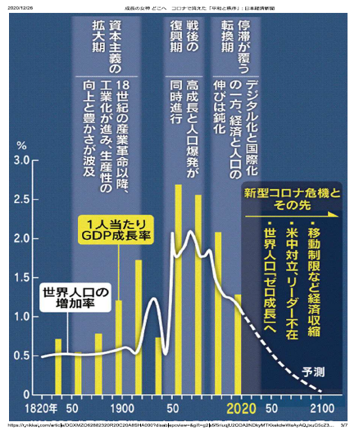
Lastly, I would like to show one chart. It is reproduced from a Nikkei article dated September 6, 2020.
(Source: Nikkei online)
Going forward, global population growth is expected to gradually decline and reach almost zero by 2100. As you know, Japan’s population growth is already significantly negative. We are living in a post-COVID world, an ESG era, a super-aged society, and an era of 100-year lives. The capitalist system itself, which assumes growth, may gradually see its driving force eroded. Perhaps the world no longer needs so many listed companies. Asset managers like us are in exactly the same position. But nothing begins if we become pessimistic. With this long-term reality in mind, and with the understanding that the world will become even more digitalized, app-based, and data-driven, let us — managers and investors, both as human beings with blood running through our veins — boldly take on the challenge together of asking what we can leave behind. Surely none of us wants to see the market ruled by AI, which was created by humans and feeds on human tendencies.
Thank you very much for your support last year. While sincerely hoping that COVID-19 will come under control as soon as possible, I very much look forward to seeing all of you again this year.
Sincerely,
January 2021
Hibiki Path Advisors
Yuya Shimizu
Representative Director and Chief Investment Officer
While every effort has been made to ensure the accuracy of the data and information contained in this suggestion, the accuracy cannot be guaranteed. This suggestion does not constitute a solicitation to subscribe for, or a recommendation to buy or sell, any specific securities, nor does it constitute investment, legal, tax, accounting, or other advice.