
On July 15, 2026, IG Port, Inc. (securities code: 3791; hereinafter the “Company” or “IG Port”), one of the portfolio companies of Hibiki Path Advisors SPC (“Hibiki,” “we,” “us,” or “our”), announced its financial results, together with an updated rolling forecast under its medium-term management plan (“MTP”), including a substantial downward revision to its outlook which resulted in sharp 18% decline in share price since pre-MTP closing price to yesterday. Additionally, it announced the new 2.75% dividend on equity (“DOE”) policy starting from this year to support the dividend level. We would first like to discuss DOE and then offer our views on the revised MTP here in today’s post.
We have been a long-term shareholder in IG Port since 2017. Over the past decade, we have watched with great encouragement—and actively supported—its transformation from a brick and mortar anime studio and publishing, becoming into one that handles the broader lifecycle of anime IP, especially through investment and obtaining the rights for various IPs, and this led the company to achieve both substantial increase in cash-flow as well as stability. During this period, the Group has produced numerous major hits, including the long-running Legend of the Galactic Heroes, Attack on Titan, SPY×FAMILY, and Haikyu!!. It was a remarkable decade—one in which IG Port demonstrated the strength of its production capabilities to audiences around the world. With that said, its share price rose nearly eightfold, from JPY 301.8 at the end of 2014 (stock splits adjusted) to JPY 2,412 at the end of 2024.
The Company has continued to evolve since then, despite a rapidly changing business environment. Recent developments include taking on production of a new mega IP “ONE PIECE” project as well as entering into a capital alliance with Sanrio, the Hello Kitty company. Recently, however, that trajectory appears to have shifted. In particular, as illustrated by the sharp decline in the share price following the latest revision to the MTP, we have concerns not only about its contents, but also about the underlying approach to the plan itself. In the spirit of candid but constructive encouragement to management, we would like to explain two principal concerns regarding the MTP. We urge the management team to use these observations as a source of rejuvenation of its high-standard discipline, and once again establish a clear path toward maximizing corporate value.
Before turning to those concerns, we would first like to address the introduction of DOE. We believe that announcing this change at this particular juncture was a bold and wise decision. For many years, we have advocated for DOE-based dividend policies to the management teams of all our portfolio companies, highlighting both their positive signaling effect on share prices and the sound underlying logic deriving from the long history of corporations. DOE offers two principal advantages: (i) in theory, provided a company remains profitable—and its equity therefore continues to grow—dividends should increase steadily from year to year, creating a signaling effect that supports share-price stability through greater dividend visibility and stable growth; and (ii) long-term investors can more readily understand the relationship between financial strategy and shareholder returns, as well as the underlying policy design, because DOE indicates how much of a company’s target ROE is to be distributed as dividends. In other words, by designing dividends as part of a broader business cycle rather than on a single-year basis, a company can demonstrate a clear commitment to the market on its long-term focus.
In IG Port’s case, following the substantial downward revision to the MTP, maintaining the previous policy of a 25% payout ratio would have resulted in a sharp dividend cut for the current fiscal year alongside the significant shrinkage in earnings. This would also have removed the downside support provided by the stock’s dividend yield. We therefore believe the introduction of DOE helped prevent that outcome. Although we would discuss the revision in greater detail in the latter part of this post, as a snapshot, the aggregate reduction in operating profit across FY5/26 through FY5/28—measured for FY5/26 as the difference between the previous MTP forecast and the actual result—amounted to JPY 2.3 bn, or 44% of JPY 5.2 bn initial plan. Assuming a rational investor, a revision of this magnitude comes close to wiping out ALL future growth expectations. In that case, it would not have been surprising for the share price to fall back to the long-term average P/B ratio of approximately 1.5x that prevailed before the step-up in cash flow and valuation from increased investment in IP began to emerge around FY5/22. Based on FY5/26 BPS, this would imply a share price of around JPY 750. The DOE policy appears to have played a significant role in supporting the shares at around 2.0x P/B.
For companies such as IG Port that bring IP to market through publishing and animation production, the value associated with rights to the various IP they create or publish is not reflected in book value under Japanese accounting standards, because the related costs are immediately expensed or amortized when a program is broadcast or a film is released. We therefore believe that intrinsic shareholder value substantially exceeds the amount of book equity shown on the balance sheet. However, when shareholders and investors become pessimistic about that future value—as is currently the case with IG Port—the relationship can become materially distorted to the downside. Against this backdrop, the DOE-based dividend policy had meaningful value in helping prevent a sharp decline in the share price by committing to at least a firm floor for dividends. We appreciate management’s willingness to make a clear commitment to avoid a dividend cut even during a challenging period for earnings.
We now turn to the latest revision of the MTP. We would like to comment on the following two points:
① The Drawbacks of a Rolling Plan—and What an MTP Is Meant to Be
② IG Port’s Group Oversight Function and Management’s Intent
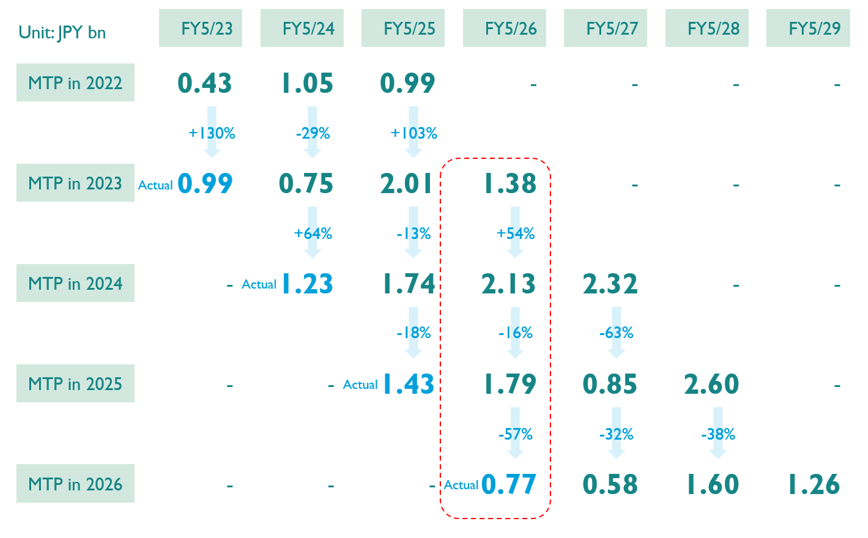
The figure below traces how the operating profit forecasts in the MTPs published since 2022 have changed over time.
Figure: Evolution of Rolling Operating Profit Forecasts and Actual Results
(Source: Company IR materials)
Take the FY5/26 forecast, highlighted by the red dashed line in the figure. The MTP published in 2023 projected operating profit of JPY 1.38 bn. This was raised sharply to JPY 2.13 bn in the 2024 rolling plan, cut to JPY 1.79 bn in 2025, and ultimately came in at just JPY 766 mn. Similarly, the FY5/27 forecast, initially published at JPY 2.32 bn in the 2024 plan, has been cut to JPY 579 mn in the current plan.
Our first concern relates to “① The Drawbacks of a Rolling Plan—and What an MTP Is Meant to Be.” At the outset, we are concerned that the very use of a rolling framework for the MTP may have blurred both the rigor with which target levels are set and the execution protocols through which those targets are translated into concrete tactics. As a shareholder, we fully understand the characteristics and risks of this business, including the potential for annual plans to fluctuate significantly as a result of delays in the delivery of major titles or changes in release timing. Even so, two aspects of the latest results and revision to the MTP stand out to us from an operational perspective.
First, there was a substantial budget overrun on productions undertaken by the former SIGNAL.MD, Inc., which was merged into Production I.G, Inc. in 2025, with an impact of negative JPY 770 mn. Second, operating profit from the merchandise business—a new business comprising primarily character-goods sales—was cut by a cumulative JPY 3.0 bn across FY5/27 and FY5/28, and the business is now expected to remain close to break-even over the next two years. This appears to represent a 180-degree shift in the Company’s stance toward the business itself.
More fundamentally, in our view, an MTP should not be a mere aggregation of budgets or broad expectations presented to the market. It should aim at what we see as the fundamental mission of a listed company—maximizing the aggregate value of future cash flows—and serve as a declaration and commitment to all stakeholders, both inside and outside the Company, setting out what the Company will do and how it intends to grow over the next three to five years to achieve that objective. Many companies also conduct and publicly disclose a self-assessment of their progress against the MTP and the accuracy of their forecasts, including lessons learned and areas for improvement, and use that reflection to further strengthen the drive for growth.
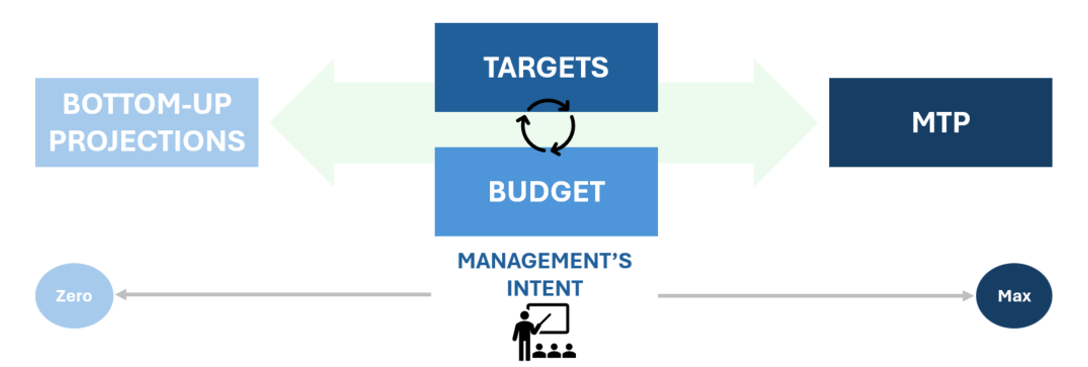
Our second concern relates to ② IG Port’s Group oversight function and management’s intent, which is closely connected to the first point. Please refer to the figure below.
(Source: Hibiki Path Advisors SPC)
As illustrated, companies generally begin with budgets at the project level and aggregate them at the unit or business level. The corporate planning function and senior management then debate these figures repeatedly with the objective of maximizing corporate value—in other words, maximizing future cash flow—and typically formulate the MTP with a commitment to clear a demanding hurdle at the Group level. In practice, the aggregate of the internal targets assigned to individual businesses is often higher than the targets disclosed in the MTP. Given the macroeconomic risks and other factors beyond a company’s control, it is entirely reasonable for management to incorporate an appropriate risk buffer into its judgment.
The fundamental point we wish to make, however, is that—as the figure illustrates—an MTP should not be mere publicity. It should embody management’s “intent” and “resolve.” In this current case, the Board of Directors of IG Port, the listed entity at the top of the holding-company structure, is the ultimate decision-making body responsible for articulating such. Its role in corporate governance is to drive the operating companies and keep a close watch on how they are performing. But management focusing solely on “control” may easily lead to the whole business becoming reluctant in taking risks, resulting in shrinking future cash flow and, ultimately, downhill. A strong hunger for growth must therefore run as a constant undertone through the management of a listed company. This strong intent is exactly what enables management to take the necessary risks with conviction. Frankly, looking solely at the figures in the latest MTP, we were left questioning whether there is truly a strong determination to grow the IG Port Group.
In recent years, it has become increasingly common for companies to establish a management strategy committee or similar forum, separate from the Board meetings, where key executives and external advisers meet regularly for rigorous discussion focusing on questions such as “How should our company look like in ten years?” and “What must we do to achieve that?” Senior management roles are exceptionally demanding at every company, and executives are occupied with day-to-day decisions. Precisely in today’s VUCA environment, however, it is increasingly important to step back, define the Company’s mission clearly from a long-term perspective, and envision the path toward it in as much concrete detail as possible to support sustainable development. If IG Port already has such a process in place, we strongly encourage the Company to express that vision in its MTP. If no such forum has yet been established, we encourage the Company to consider introducing one.
For IG Port in particular, we believe a broader perspective is needed on how to capture value across the entire lifecycle of IP. The Company still has almost no debt, while JPY 6.9 bn of cash—equivalent to 46% of total assets—remains on the balance sheet, with no clear indication of how that capital will be allocated in the future, particularly how it will be used for growth. To expand future cash flow rather than fall into a shrinking equilibrium, management needs to show how those resources will be deployed, what kinds of hit titles the Group aims to create, and how it intends to participate across the full lifecycle of those titles. Articulating this is a necessary part of the fundamental responsibility of management at IG Port as a listed company.
As a shareholder, we remain deeply captivated by the distinctive character and richly imaginative works of the many anime and manga works brought to audiences by Production I.G, Inc. and WIT STUDIO, Inc., as well as by Mag Garden Corporation. The alliance with Sanrio has also led the Group to explore new forms of creative expression and new approaches, and we continue to have high expectations for the future growth of the IG Port Group. We also recognize the tremendous dedication of the many employees involved in production and the powerful energy that comes from their desire to create outstanding works.
That said, in theory, a share price is an approximation of shareholder value per share, while shareholder value is the present value of future cash flows less debt. Market expectations may cause the share price to deviate above or below that theoretical value at any particular point in time, but ultimately, a company’s value depends on whether it can increase—or whether it allows to shrink—its medium- to long-term cash flow by making the best possible use of its people, assets, and capital.
If management wants the share price to rise, the first priority should therefore not be to raise market expectations at a particular moment in time. It should be to formulate and execute a business strategy that increases future cash flow. And the MTP is where management should show the market how it intends to do exactly that. The ultimate mission of the management of a listed company is to maximize future cash flow, and in turn corporate and shareholder value, despite changes in the external environment and the headwinds the business may face. To fulfill that responsibility, management must maintain a firm grasp of conditions at each operating company and, with growth as its objective, take responsibility for resource allocation and bold investment decisions, i.e. risk-taking.
In this post, we have deliberately spoken candidly as the Company’s “tough friend,” with the intention of offering both criticism and encouragement. We hope that IG Port’s management will engage in earnest discussion of the two issues we have identified: (i) the shortcomings of a rolling MTP and what an MTP is meant to be; and (ii) Group oversight and management’s intent and resolve. Above all, we hope to see a strong IG Port once again—one that demonstrates a powerful determination to grow and executes on that determination with precision.
This post does not constitute a proposal, solicitation, marketing communication, advertisement, inducement or representation in respect of any service or product, nor does it constitute advice to buy or sell any investment product or any investment of any kind, or a recommendation to purchase or sell any investment product, make any investment, execute any transaction, or refrain from taking any other action, whether or not any terms are described. It also does not constitute an opinion regarding the merits of any particular investment or investment strategy. Any examples of strategies or transactions are provided solely for illustrative purposes and do not indicate any past or future strategy or performance, nor do they indicate the likelihood of success of any particular strategy. This post does not constitute investment, financial, legal, tax, or any other advice.
This post presents our assessments, estimates, and opinions regarding the business of IG Port, Inc. (“IG Port”) and IG Port group companies.
This post has been prepared based on publicly available information, which we have not independently verified, and is not complete, timely, or comprehensive.
Although we believe that the information contained in this post is accurate and reliable, we make no representation or warranty as to the accuracy, completeness, or reliability of such information, or of any statements or oral communications regarding IG Port, IG Port group companies, or any other companies described herein. We also assume no responsibility for any such statements or communications, including any inaccuracies or omissions therein. With respect to public companies, there may be non-public information held by such companies or their insiders that has not been disclosed by those companies. Accordingly, all information contained in this post is presented “as is,” without any warranty of any kind, and we make no express or implied representation as to the accuracy, completeness, or timeliness of such information, or the results of its use. Readers should obtain their own professional advice and make their own assessment of the relevant matters. We disclaim any obligation or liability for any loss arising from, or in connection with, the use of all or any part of the information contained in this post, including any inaccuracies or omissions therein. Any investment involves significant risks, including the risk of a complete loss of capital. Any forecasts or estimates are provided solely for illustrative purposes and should not be regarded as indicating any upper limit of potential gains or losses. We may modify all or part of this post without notice to any person, but we are under no obligation to provide any revisions, updates, additional information or materials in relation to this post, or to correct any inaccuracies.
This post may contain content or quotations from, or hyperlinks to, publicly available third-party sources of information (“Third-Party Materials”). Permission to quote Third-Party Materials in this post may not have been sought or obtained. The contents of Third-Party Materials have not been independently verified by us and do not necessarily reflect our views. The authors and/or publishers of Third-Party Materials are independent from us and may hold views that differ from ours. The inclusion of Third-Party Materials in this post does not imply that we endorse or agree with any part of the content of such Third-Party Materials, nor does it imply that the authors or publishers of such Third-Party Materials endorse or agree with the views expressed by us in relation to the relevant matters. Third-Party Materials do not constitute all relevant news reports or views expressed by third parties regarding the matters discussed herein.
We do not intend, either by ourselves or through other shareholders, to propose at a general meeting of shareholders of IG Port that the business or assets of IG Port or IG Port group companies be transferred to a third party or discontinued. We also have no intention of engaging in any conduct whose purpose would be to make it difficult for IG Port or IG Port group companies to continue conducting their businesses in a stable and ongoing manner.
We currently beneficially own and/or have an economic interest in securities of IG Port and/or IG Port group companies, and may continue to beneficially own or have an economic interest in such securities in the future. With respect to our investment in IG Port and/or IG Port group companies, we may, on an ongoing basis and depending on various factors — including the financial condition and strategic direction of IG Port and IG Port group companies, the results of discussions with IG Port and IG Port group companies, overall market conditions, other investment opportunities available to us, and the possibility of purchasing or selling securities of IG Port and IG Port group companies at prices at which we desire to transact — at any time, including through open-market or private transactions after we have established a position, buy, sell, cover, hedge, or otherwise change the form or substance of our investment, including securities of IG Port and IG Port group companies, in any manner permitted by applicable laws and regulations, and we expressly disclaim any obligation to notify others of any such changes. We reserve the right to take any actions we deem appropriate in relation to our investment in IG Port and IG Port group companies. Such actions may include, but are not limited to, communications with the board of directors, management, or other investors.