
In July 2026, Hibiki Path Advisors SPC (“we,” and/or “us,”) had the opportunity to visit the Ryuyo Factory of Kawai Musical Instruments Manufacturing Co., Ltd. (securities code: 7952; the “Company” or “KAWAI”), one of our core investments since 2023. Ryuyo Factory is the foundation of value behind KAWAI’s piano craftsmanship. In this post, we would like to share not only about the factory tour itself, but also the thoughts, questions, and reflections that came out of the visit.
First, about the Ryuyo Factory. The factory was completed in 1980 as a dedicated grand piano manufacturing facility. Today, it serves as KAWAI’s mother factory for acoustic pianos, supporting a full product lineup that ranges from the Company’s highest-end Shigeru Kawai series to the GX and GL series, upright pianos, and Boston pianos, which KAWAI manufactures as an OEM supplier for Steinway & Sons.
The factory is located along the coast, about 30 minutes by car from Hamamatsu Station on the Tokaido Shinkansen line. The site covers approximately 170K ㎡, roughly the size of 20 soccer fields, and includes facilities for parts manufacturing, keyboard production, painting, and other key processes. A defining feature of the factory is that KAWAI carries out many of these major processes in-house. During this visit, we were able to see the final assembly process, which is likely one of the most labor-intensive stages of piano manufacturing.
Our first impression was very simple: we were genuinely amazed by the craftsmanship embedded in each and every piano. There is the physically demanding work of stringing the piano. There are the sub-millimeter visual adjustments needed to ensure that each hammer strikes the strings evenly. There is the painstaking work of regulating all 88 keys so that their alignment and touch feel consistent. And these are only a few examples. Many parts of the process still depend heavily on human hands, eyes, and judgment. Rather than a conventional factory, the Ryuyo facility felt to us much more like a workshop, where skilled craftsmen devote themselves to creating each instrument.
We also had the opportunity to attend a lecture on the piano manufacturing process. For example, we learned that the soundboard, the large wooden board that creates the rich resonance of a piano, is not dried through an artificial process, but naturally seasoned over a long period of time to improve acoustic quality. We also heard that the spruce used for these soundboards often needs to grow for more than 100 years before it can be used, and that reforestation is also carried out as part of this long-term cycle. Listening to these stories reminded us that the piano is an instrument built on an extraordinarily long time horizon, and one that has developed in deep harmony with nature. It also gave us a chance to reflect on the weight of more than 300 years of piano-making history.
Today, society continues to move almost relentlessly toward digitalization and artificial intelligence. As a business, it is of course important to capture future growth areas, and KAWAI has rightly positioned digital pianos as one of the pillars of its growth strategy. At the same time, after seeing firsthand the depth of craftsmanship behind an acoustic piano — a sophisticated precision instrument built around wood and made from some approximately 10,000 components — we came away feeling that the acoustic sound produced by such an instrument is far from disappearing. In fact, across human entertainment more broadly, recent trends toward “real” or “immersive” experiences, analog experiences, and “live performance” experiences seem to reflect a growing desire among digital-native generations for a form of digital detox. From that perspective, our visit made us feel that the time may not be far away when acoustic pianos are once again appreciated in a new light. In that sense, our visit to the Ryuyo Factory was a truly valuable experience.
At the same time, precisely because the craftsmanship is so impressive, we also felt that KAWAI still faces important management challenges as a listed company expected to keep improving profitability and earnings. In particular, the Company needs to continue refining the balance among three things: i) preserving its craftsmanship, ii) ensuring that the quality of its products is properly recognized by customers and reflected in pricing, and iii) managing profitability and manufacturing costs.
In our 2023 proposal letter to KAWAI, we included the following chart. At the time, Steinway had disclosed financial information through its IPO filing. Since Steinway later withdrew its listing application, FY2021 remains the latest financial year for which public financial information is available.
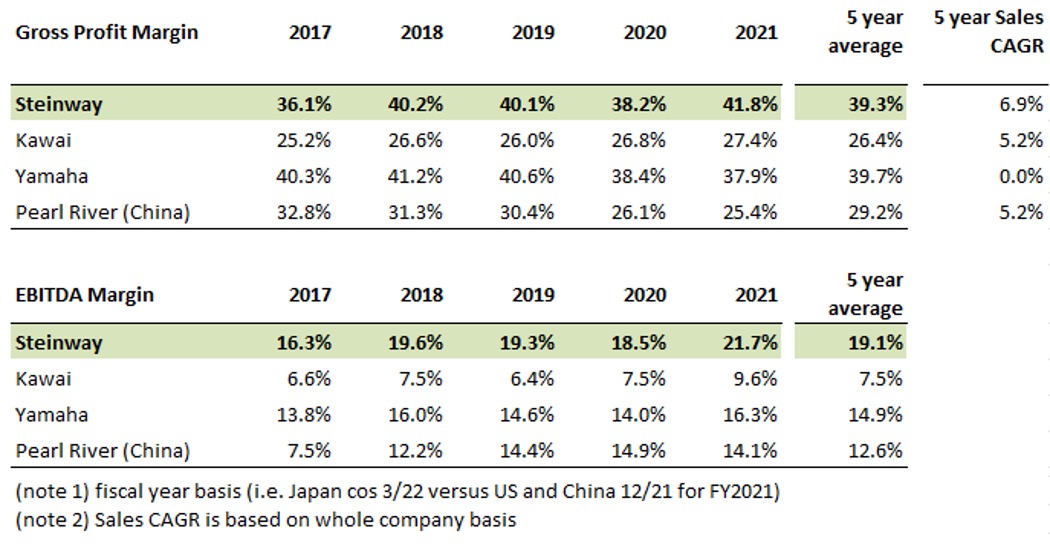 (Source: Bloomberg and Company financials)
The gap between Steinway, which is nearly a pure-play piano company, and KAWAI is significant: roughly 15 % in gross profit margin and more than 10 % in EBITDA margin. From the outside, we cannot know exactly what explains this difference. However, KAWAI has been manufacturing Boston pianos, Steinway’s important mid-line brand, under an OEM arrangement since 1992 and Boston pianos remain an important source of earnings at the Ryuyo Factory today. Given this relationship, we wonder whether part of the answer may already lie within KAWAI itself.
For example, KAWAI maintains very high quality by manufacturing many key components in-house, including hammers and actions, which transfer the movement of the keys to the strings. But this also raises an important question: which technologies are truly core to KAWAI and must be kept in-house? And when we look not only at quality preservation, but also at profitability — which is essential for any manufacturer to keep reinvesting in itself — is the current procurement and production structure really the best answer? If the sole objective were to preserve and pass on craftsmanship, then full in-house production would probably be the ideal scenario, as is often the case in manufacturing. But business is ultimately about competition. Only by building competitive advantages and expanding profits can a company continue to reinvest in itself and improve the well-being of its employees.
We understand that, at present, KAWAI’s experienced craftsmen are able to produce these components with such efficiency and quality that in-house manufacturing is actually more cost-effective than outsourcing. That is an important point. Still, from a longer-term perspective, especially as these highly skilled craftsmen eventually retire, we became very interested in how the Company is thinking about the optimal production model that can preserve quality while also sustaining competitive advantage.
Steinway, for example, is both a respected competitor and an important customer of KAWAI. For centuries, it relied on external suppliers for several core components. Keyboards came from Kluge Klaviaturen in Germany, hammers and actions from Louis Renner, also in Germany, and cast-iron plates from O.S. Kelly in Ohio, which support the overall structure of the piano. Steinway would then assemble these components in-house and refine the specifications to the highest possible standard. In some ways, this approach resembles the Toyota Production System, bringing together specialized supplier capabilities under strict specifications and disciplined final integration. Steinway later acquired all three of these companies. Even today, however, they continue to operate as separate legal entities with their own production processes. They also continue to take orders from outside customers, allowing them to keep innovating as independent businesses.
Another respected competitor, Fazioli, focuses exclusively on the highest-end grand pianos and produces only around 150 per year. Given this limited production scale, it does not have the capacity to absorb the fixed costs of manufacturing keyboards, hammers, and actions internally. As a result, Fazioli still sources many of these components mainly from the same two German companies that are now part of the Steinway group. Of course, Fazioli specifies extremely detailed design requirements and carries out highly proprietary final adjustments at its own factory after procurement. Still, these examples show that there are many different ways to express an uncompromising commitment to product quality.
Because KAWAI’s main production base is in Japan, sourcing major component modules from Europe may not be economically practical. If that is the case, however, it becomes even more important for KAWAI to communicate the value embedded in its fully integrated manufacturing process — where production and quality control are managed in-house — and to build a brand that can translate that hidden value into appropriate pricing. This may also be deeply connected to the reason Steinway entrusted KAWAI with the manufacturing of Boston pianos some 30 years ago. This factory visit therefore brought us back to two fundamental questions: What is KAWAI’s true strength? And how can the Company make customers and the market recognize that strength more clearly? For us, these were among the most important takeaways from the visit, and they are questions we hope KAWAI’s management team and operational leaders will continue to ask themselves.
Additionally, through our own additional research, we also learned that Steinway and Fazioli, despite being fierce competitors, source certain components from the same suppliers. If we can assume that KAWAI’s original components are indeed among the best in the industry, there may also be room to create new earnings streams by supplying those components to third parties, such as Chinese manufacturers, at fair prices. There may even be scope to consider sharing certain components with Yamaha, in some areas, for the long-term sustainability and development of the industry as a whole. These may sound like unconventional ideas. But they may also point to new ways of securing profitability that have not traditionally been considered.
The deep technical expertise and craftsmanship held by a company like KAWAI may be described as a form of tacit knowledge. But if that tacit knowledge cannot be translated into sustainable brand value — or, in economic terms, excess returns — it risks remaining unrecognized within a capitalism framework. If that happens, the Company may find it difficult to sustain its own long-term renewal and reinvestment to grow. As shareholders who invested in KAWAI because we strongly believe in the realization of its intrinsic value, we sincerely hope that President Kawai and the management team will embrace the spirit of Fueki Ryūkō — preserving what should never change, while actively embracing what must change — and execute the “Kawai Ten-Year Plan” with discipline, leaving no sacred cows untouched.
Today, KAWAI’s earnings remain well below the record level achieved in FY2021. The stock market’s valuation of approximately 0.6x P/B is, frankly, harsh. This stands in stark contrast to the sharp rise in KAWAI’s global reputation following the 2025 International Chopin Piano Competition. After seeing with our own eyes the dedication and craftsmanship of the people on the factory floor, who create KAWAI’s value every day, we strongly felt that a valuation of 0.6x P/B does not fairly reflect the value they are creating. At the same time, we hope KAWAI’s management will bring even greater sharpness and urgency to its management strategy, particularly in its production philosophy, branding strategy, and sales execution, so that the Company’s true strengths can be more fully recognized by the capital markets.
As a very committed shareholder supporting KAWAI’s growth, and more precisely, as a “close yet tough friend,” we will continue to engage with KAWAI in a constructive dialogue in its journey to maximize its corporate value.
EOD
(Our History of Engagement)
24/Jun/2026 – Update on Kawai’s Europe Business
15/Jun/2026 – Kawai Musical Instruments Manufacturing: Large Shareholding Report
21/Oct/2025 – Update on the International Chopin Piano Competition
13/Oct/2025 – KAWAI’s Remarkable Progress at the Chopin Competition
31/May/2025 – Discussion on the medium-term management plan with Kawai Musical Instruments Manufacturing
23/Mar/2025 – Commentary on Medium-Term Management Plan of Kawai Musical Instruments Mfg
04/Dec/2024 – Discussion with Kawai Musical Instruments Manufacturing Co., Ltd.
23/Aug/2023 – Discussion with Kawai Musical Instruments Manufacturing Co., Ltd.
27/Jun/2023 – About AGM of Kawai Musical Instruments Manufacturing Co., Ltd.
11/Jun/2023 – Introduction of Follow-up Engagement Video about Kawai Musical Instruments Manufacturing
18/May/2023 – Engagement Explanation Video about Kawai Musical Instruments Manufacturing Co., Ltd.
08/May/2023 – Letter to Kawai Musical Instruments Manufacturing Co., Ltd.
This post does not constitute a proposal, solicitation, marketing communication, advertisement, inducement or representation in respect of any service or product, nor does it constitute advice to buy or sell any investment product or any investment of any kind, or a recommendation to purchase or sell any investment product, make any investment, execute any transaction, or refrain from taking any other action, whether or not any terms are described. It also does not constitute an opinion regarding the merits of any particular investment or investment strategy. Any examples of strategies or transactions are provided solely for illustrative purposes and do not indicate any past or future strategy or performance, nor do they indicate the likelihood of success of any particular strategy. This post does not constitute investment, financial, legal, tax, or any other advice.
This post presents our assessments, estimates, and opinions regarding the business of Kawai Musical Instruments Manufacturing Co., Ltd. (“KAWAI”) and KAWAI group companies.
This post has been prepared based on publicly available information, which we have not independently verified, and is not complete, timely, or comprehensive.
Although we believe that the information contained in this post is accurate and reliable, we make no representation or warranty as to the accuracy, completeness, or reliability of such information, or of any statements or oral communications regarding KAWAI, KAWAI group companies, or any other companies described herein. We also assume no responsibility for any such statements or communications, including any inaccuracies or omissions therein. With respect to public companies, there may be non-public information held by such companies or their insiders that has not been disclosed by those companies. Accordingly, all information contained in this post is presented “as is,” without any warranty of any kind, and we make no express or implied representation as to the accuracy, completeness, or timeliness of such information, or the results of its use. Readers should obtain their own professional advice and make their own assessment of the relevant matters. We disclaim any obligation or liability for any loss arising from, or in connection with, the use of all or any part of the information contained in this post, including any inaccuracies or omissions therein. Any investment involves significant risks, including the risk of a complete loss of capital. Any forecasts or estimates are provided solely for illustrative purposes and should not be regarded as indicating any upper limit of potential gains or losses. We may modify all or part of this post without notice to any person, but we are under no obligation to provide any revisions, updates, additional information or materials in relation to this post, or to correct any inaccuracies.
This post may contain content or quotations from, or hyperlinks to, publicly available third-party sources of information (“Third-Party Materials”). Permission to quote Third-Party Materials in this post may not have been sought or obtained. The contents of Third-Party Materials have not been independently verified by us and do not necessarily reflect our views. The authors and/or publishers of Third-Party Materials are independent from us and may hold views that differ from ours. The inclusion of Third-Party Materials in this post does not imply that we endorse or agree with any part of the content of such Third-Party Materials, nor does it imply that the authors or publishers of such Third-Party Materials endorse or agree with the views expressed by us in relation to the relevant matters. Third-Party Materials do not constitute all relevant news reports or views expressed by third parties regarding the matters discussed herein.
We do not intend, either by ourselves or through other shareholders, to propose at a general meeting of shareholders of KAWAI that the business or assets of KAWAI or KAWAI group companies be transferred to a third party or discontinued. We also have no intention of engaging in any conduct whose purpose would be to make it difficult for KAWAI or KAWAI group companies to continue conducting their businesses in a stable and ongoing manner.
We currently beneficially own and/or have an economic interest in securities of KAWAI and/or KAWAI group companies, and may continue to beneficially own or have an economic interest in such securities in the future. With respect to our investment in KAWAI and/or KAWAI group companies, we may, on an ongoing basis and depending on various factors — including the financial condition and strategic direction of KAWAI and KAWAI group companies, the results of discussions with KAWAI and KAWAI group companies, overall market conditions, other investment opportunities available to us, and the possibility of purchasing or selling securities of KAWAI and KAWAI group companies at prices at which we desire to transact — at any time, including through open-market or private transactions after we have established a position, buy, sell, cover, hedge, or otherwise change the form or substance of our investment, including securities of KAWAI and KAWAI group companies, in any manner permitted by applicable laws and regulations, and we expressly disclaim any obligation to notify others of any such changes. We reserve the right to take any actions we deem appropriate in relation to our investment in KAWAI and KAWAI group companies. Such actions may include, but are not limited to, communications with the board of directors, management, or other investors.